- Key Takeaways
- The Idea Behind a Machine Route Business
- 1. Digital Jukebox Placement
- 2. Coin Op Pool Tables and Electronic Dartboards
- 3. The Boxing Strength Test Machine
- 4. The Breathalyzer Vending Machine
- The Handshake Mistake: Put the Split in Writing
- 5. Coin Op Air Hockey and Table Shuffleboard
- 6. Arcade Basketball and Skee-Ball Lanes
- 7. Pinball Machine Placement
- What Happened to Harry
- Three Filters Before You Pick a Machine
- Watch the Full Video
A single jukebox can bring in around a thousand dollars a month in one bar, and the bar does not even own it. That is what one bar owner told a Reddit forum. Someone else bought the machine, parked it by the wall, and comes back once a week with a key. This is the quiet appeal of the boring business built on amusement machines: the room is the most expensive part of almost any business, and here the venue has already paid for it.
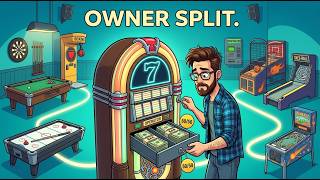
Below are seven coin operated machines you can place in a bar, pizza place or bowling alley, and split the cash box with the owner. For each one you will see what it takes in, how the split works, and what the machine costs new and used. The list starts with the easiest, the digital jukebox, and ends with pinball, where one small crew has proven a real route can grow.
Key Takeaways
- Seven machines run on one idea, the Parked Profit Split: you bring the machine, the venue brings the crowd and pays the rent.
- The usual split is fifty fifty with the venue, though pinball operators sometimes argue for sixty or seventy percent to the operator.
- Used machines cut the entry cost sharply: a used Valley pool table was listed at $1,500, against $6,895 for a new Panther.
- The breathalyzer vending machine is the cheapest door in, at about $999 to $1,900, but the weakest earner per machine.
- Write the split down before any machine lands. A handshake deal can leave you and the owner with two different memories.
- Many states require a license or decal for amusement machines, so check your city's and state's rules first.
For educational purposes only. This is not financial advice. Machine prices, splits and earnings vary by room and change over time. The numbers here are examples, not promises.
The Idea Behind a Machine Route Business
Most people assume a business starts with a lease, staff and a sign out front. A machine route skips all of that. The bar pays the rent, the staff, the lights, the heat and the sign. The bar even brings the crowd. You bring one machine, and the cash box pays you both. This guide calls it the Parked Profit Split.
It also fits a point made by Michael Gerber in The E-Myth Revisited: many small businesses depend on the owner showing up for every hour of work, so build one that runs on a system instead. A machine on a wall works the whole shift. You only show up to open the box.
To make it concrete, follow Harry, who fixes commercial dishwashers for a living. One Tuesday he watched a man with a ring of keys open a jukebox, count the cash with the owner on the bar top, hand over half and leave. Ten minutes. Harry decided to buy one machine of his own.
1. Digital Jukebox Placement
The jukebox is the easiest place to start. A bar owner on Reddit says one machine makes around a thousand dollars a month, while another on the same thread says theirs usually makes about two hundred. An older benchmark, a TouchTunes report filed with the SEC in 2004, put the average digital jukebox at about $204 a week in gross plays. Small bars land low, busy bars land high.
A digital jukebox is a screen on the wall. People pay to pick songs, and the music arrives over the internet, so there are no records to change. Coin Op Games says the standard deal is fifty fifty between the bar and the operator, with no upfront cost to the bar. Meadowbrook Amusements states the same: TouchTunes money is split fifty fifty after the TouchTunes fees. Coin Op Games puts those fees at about twenty percent for music licensing, plus about $30 a month for wireless service. In their example, a $600 month pays the bar $300 and the operator roughly $180 to $210 after fees.
A used TouchTunes Angelina was listed on eBay for $3,750, plus $300 for delivery. Social Amusements Company in Downey, California places TouchTunes and AMI jukeboxes, and pool tables, in bars across Los Angeles, Orange and San Bernardino counties. Their pitch is a free jukebox and a split. IBISWorld counts close to seventy thousand bar and nightclub businesses in the United States, and you only need a few.
As an example, not a promise: one jukebox in month one, three by month six at about $195 each after the bar and fees (around $585 a month), and five by month twelve for close to a thousand dollars a month from one weekly round. Keep the TouchTunes account and the music license in your name. Licensing varies by state: South Carolina puts jukeboxes in its Type one class with a $50 license and $50 decal for two years, and Texas charges $60 a machine each year.
2. Coin Op Pool Tables and Electronic Dartboards
LeaguePool says a current Valley Panther table ships set at one dollar a game. HomeBilliards works it out at $1.50 a game and ten games a day, which is about $450 a month per table. One forum poster in a small town at a quarter a game reported about $600 a month years back. Meadowbrook Amusements splits pool table money fifty fifty with the venue, and TDS Amusements offers bars a fifty percent share.
A new seven foot Valley Panther lists at $6,895, but used tables are far cheaper: a used Valley coin table was listed on Craigslist in San Jose for $1,500 and another on eBay for $1,675. The dartboard is the natural pair. Pinball Alley in Rochester, New York sells a refurbished Arachnid Galaxy 2.5 dartboard for $2,295. Darts keep people around longer, and longer nights mean more songs on the jukebox. Budget for felt and cushions, which wear on a schedule. South Carolina places billiard tables in the same cheap Type one class as jukeboxes.
3. The Boxing Strength Test Machine
A padded bag pops down, someone punches it, and the screen shows a score. Then their friend has to beat it. Blee Arcade says a dollar or two a play. I could not find a real operator's weekly take for a boxing machine, so use the general bar numbers: Coin Op Games, citing bar owners, says a single machine in a small bar takes in $80 to $150 a week, and a busy college bar machine takes in $300 to $600. Split fifty fifty, that is the range.
M and P Amusement in York, Pennsylvania lists a new Kalkomat Boxer Spider at $6,495 with an electronic coin acceptor. Blee Arcade puts basic boxing machines at $1,000 to $2,000 and commercial grade at $2,000 to $4,000. It is the loudest machine in the room, so it suits a sports bar on fight night or a place where groups of friends arrive late.
4. The Breathalyzer Vending Machine
This unit hangs on the wall near the door with a tiny cash box. Seller Blo Dad and Sons says to price a test from $1 to $5, and it takes cash, coins or a card. One owner on a Reddit small business thread put the take at $15 to $100 a week, about $30 to $40 on average. The same seller suggests selling ad space on the machine at $30 to $50 per ad, per machine.
The Boozelator 5000 was advertised at $999 a machine from Blo Dad and Sons in Cape Coral, Florida, while a Reddit poster quoted closer to $1,900 new. Either way it is the cheapest machine on this list, with calibration and straws at about $25 a year per machine. Connor Farrell lists himself as the owner of Breathalyzer Vending in the New York City area.
It works best as an add on in a bar where you already have a jukebox or pool table, costing about two extra minutes per visit. As an example, five machines at about $35 a week each take in around $750 a month before the bar's share. Per machine, this is the weakest earner of the seven, but it is the cheapest entry and rides along on visits you already make. Check your city's rules before you hang one.
The Handshake Mistake: Put the Split in Writing
Harry's second bar went wrong at the first collection. He had agreed on the split with a handshake, and the owner remembered the deal as sixty forty in the bar's favor. Same machine, two memories.
The fix is to write the split down before the machine lands. ClawMachines says a revenue share agreement should cover the split, how often you pay, the notice to end it, who handles repairs and who carries the insurance. Harry wrote a one page agreement that night, printed a copy for every bar, and read the meter with the owner watching.
5. Coin Op Air Hockey and Table Shuffleboard
Arcade Integrations, a route operator guide, describes a Golden Tee golf game and a dart machine in one bar pulling in $160 a week together. Coin Op Games puts a single small bar machine at $80 to $150 a week. Both games are played in pairs, and a rematch is another coin.
The tables are big and so are the prices. M and P Amusement lists a refurbished commercial Dynamo Firestorm air hockey table at $5,495, and a new one runs about $9,295 at Billiard Superstore. GameTablesOnline lists new seven foot coin op air hockey tables from about $3,600 to $4,700 on sale. The Shuffleboard Federation lists a new Championship Line coin op table at $9,485, plus $695 for a bill acceptor. Shuffleboard needs length, so measure the room first. Pizza places with a back room and bars with an empty wall are the best fits.
6. Arcade Basketball and Skee-Ball Lanes
This category has the biggest take so far. Coin Op Games says a busy college bar machine takes in $300 to $600 a week. Report Desk, in a planning example, shows a machine taking in $1,170 a month, with the operator keeping $585 at fifty fifty. That is a planning figure, not a promise.
These are not cheap starts. M and P Amusement lists a used, refurbished Hoop Fever basketball game at $4,095 and a new Collegiate Hoops at $9,995. A Skee-Ball Classic ten foot lane is listed at $8,995. Good homes include bowling alleys, family fun centers and bars with space. The Bowling Proprietors Association alone has more than 3,400 member bowling centers, and E Two Amusements runs Skee-Ball leagues, which bring the same crowd on the same night every week. South Carolina even puts Skee-Ball in its cheap Type one license class.
7. Pinball Machine Placement
Madison Pinball in Madison, Wisconsin has more than forty games placed around town. Co-founder Hilton Jones told the pinball site Kineticist that his home collection outgrew its space, so he and two friends, Sean and Garrett, started putting machines into bars. A hobby that ran out of room turned into a route.
An operator on the Pinside forum reported that machines he owns net about $800 a month, split two ways. Report Desk, in a planning example, puts a Stern Pro at ten plays a day at about $70 a week, around $300 a month. On Pinside, operators call a fifty percent location share the standard, though some argue the operator should keep sixty or seventy percent because pinball machines are expensive and need care. Settle that with the bar before the machine arrives.
I could not find a posted price for a new machine. Dealers like Game Exchange of Colorado in Denver sell new Stern Pro and Premium machines and used, refurbished ones, so ask for a quote. Report Desk puts maintenance at $120 to $250 a month on a busy machine. In South Carolina a flipper game sits in a higher license class, with a $200 license and a $250 decal for two years.
As an example, five machines by month twelve, each netting around $400 to your side as in the Pinside report, would bring around $2,000 a month. That is the top end in good rooms. Start where players already are: Madison's games sit notably in an arcade bar, and a room that loves games fills a new machine faster.
What Happened to Harry
Harry started with one used jukebox and one used pool table in a pizza place he already serviced, about $5,500 from savings. His one rule: every new machine is paid for by the cash boxes, never his paycheck. By month eighteen, as an example and not a promise, he had eleven machines in five rooms. Nine sit in small bars at around $263 a month each to his side, and two sit in a busy college bar at around $710 each. That is roughly $3,787 a month from rooms he never rents.
Three Filters Before You Pick a Machine
- Which rooms do you already visit every week? Your pizza place, bowling alley or local bar is your first pitch.
- Which machine can you buy used and keep running yourself? A pool table and jukebox are simple; pinball takes more care.
- Which owner would sign a one page split this month? Pick the room where the answer is yes.
For a free task, count the machines in the next bar, pizza place or bowling alley you visit, then count the empty corners near an outlet where one more could stand. If the second number is bigger, you have found your first spot.
If you like this style of idea, see our guide to 6 boring businesses that make money under $500 to start and our list of 5 boring $20K cash-flow machines.
Watch the Full Video
Want to see each machine and the numbers walked through visually? Watch the full breakdown on YouTube: 7 Boring Machines You Park in Someone Else's Bar. Then drop a number, one through seven, in the comments to tell us which one you would start.