- Key Takeaways
- Why a Dividend Plan for Retirees at 60 Must Be Engineered Differently
- The Now Bucket: Cash and Sequence-of-Returns Risk
- The Soon Bucket: SCHD, DIVO, and the Real Income Numbers
- The Later Bucket: DGRO and VIG as the Growth Engine
- Tax Strategy, Withdrawal Order, and the Social Security Bridge
- The Complete Portfolio Blueprint and 10-Year Projections
- Watch the Full Video Walkthrough
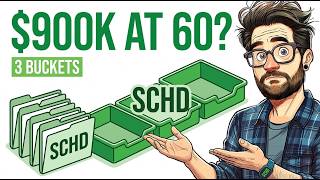
When SCHD's quarterly dividend dipped recently, investors close to retirement felt it immediately. That single data point, however, was not a warning sign — it was a rebalancing quirk, and understanding the difference is the foundation of a dividend plan built to last. What follows is the SECURE plan: five funds organized into three buckets — Now, Soon, and Later — designed specifically for someone retiring at 60 who cannot afford to learn expensive lessons in the first few years of retirement.
Key Takeaways
- A cash buffer of one to two years of expenses (Now bucket) protects against sequence-of-returns risk — the single greatest threat to an early retiree.
- SCHD and DIVO form the income engine (Soon bucket), targeting a blended yield of approximately 2.8% across the full plan.
- Pure dividend income of $3,000 per month requires roughly $1,290,000; the 4% withdrawal rule reduces that target to approximately $900,000.
- DGRO and VIG (Later bucket) grow the dividend at an average historical rate of 8.5% per year — potentially doubling the monthly paycheck over a decade without adding new capital.
- The qualified-dividend 0% federal tax bracket can make a meaningful portion of this income tax-free for moderate-income retirees.
- A dividend-funded Social Security bridge from age 60 to 70 can lock in the maximum lifetime benefit without selling growth shares at the wrong time.
Why a Dividend Plan for Retirees at 60 Must Be Engineered Differently
A 25-year-old investor can absorb a 30% portfolio loss and recover over time. A 60-year-old retiree pulling income from that same portfolio does not have that luxury. A major drawdown in the first few years of retirement — combined with ongoing withdrawals — can permanently impair a portfolio in a way that decades of future gains cannot fully repair. This dynamic, known as sequence-of-returns risk, is the central problem this plan is built to solve.
The goal is not to maximize return. It is to engineer a dividend portfolio for retirees that delivers a steady, rising paycheck through every market condition. That means deliberately avoiding leveraged funds, high-maintenance single stocks, and high-yield products promising 9% or 10% returns — yields that tend to collapse precisely when they are needed most. Every fund in this plan is boring by design. In retirement income, boring is a feature.
The Now Bucket: Cash and Sequence-of-Returns Risk
The Now bucket is cash: one to two years of living expenses held in something that does not move with the stock market. A fund like SGOV, which holds ultra-short-term Treasury bills maturing in zero to three months, fits well here. At current rates, short-term Treasuries are yielding approximately 4.5%, so this is not idle money — it earns interest while it waits. A broader bond fund such as BND is also a reasonable alternative, though it carries somewhat more interest-rate sensitivity.
The purpose of this bucket is not growth. Its purpose is to be available, unconditionally, on the worst possible day — so that a market crash in year one never forces a sale of equity shares at depressed prices just to cover ordinary expenses.
Consider two hypothetical investors, both starting retirement at $600,000 and withdrawing $30,000 per year. In year one, the market falls 20%. The investor who funds that year from the cash bucket leaves every share intact to recover. The investor who sells shares into the decline locks in those losses permanently. Modeled across the following decade, the cash-bucket investor could end up with nearly $60,000 more — from one decision, in one bad year.
The timing of building this bucket matters as much as having it. The right approach is to ease into cash over the two to three years before retirement — by redirecting dividends and contributions into the Now bucket rather than waiting until the final day of work. This approach also functions as a dress rehearsal: watching real dividend income accumulate confirms whether the paycheck will actually cover the lifestyle, while there is still time to close any gap.
The Soon Bucket: SCHD, DIVO, and the Real Income Numbers
The Soon bucket is the income engine — the funds that produce the actual monthly paycheck. It is anchored by SCHD, the Schwab U.S. Dividend Equity ETF.
SCHD holds approximately 100 American companies screened for quality and a proven history of dividend payments. Its expense ratio is just 0.06% — six cents per $100 invested — and it currently yields around 3.5%. Top holdings include names like Lockheed Martin, Texas Instruments, and Chevron: companies that have paid and grown dividends through multiple recessions. With roughly $100 billion in assets under management, SCHD is a deeply established fund. Critically, it has never cut its dividend across its entire history. The recent quarterly dip was a rebalancing artifact; the annual payout trend continued upward, and the fund gained approximately 17% year-to-date with roughly 21% total return over the trailing twelve months. An investor who understood that distinction and held — rather than reacted — will have a meaningfully better outcome over time.
DIVO sits alongside SCHD as a supplement, never a replacement. It is a covered-call fund that owns quality dividend-paying stocks and sells options against them to generate additional income, paid monthly rather than quarterly. Its yield typically runs in the mid-4% to 5% range. Monthly distributions align naturally with monthly expenses — the cash lands when the mortgage and groceries come due. The honest caveat: the covered-call structure caps upside in strong bull markets, and the income blend (qualified dividends, short-term option premiums, and return of capital) creates more complex tax treatment. For that reason, DIVO is best held in a tax-advantaged account and sized as a modest booster on top of the SCHD core — not sized to become the core itself. Too much DIVO slowly starves the long-term growth the plan depends on.
For a detailed look at how these four ETFs work together as a layered income system, the 4-ETF Dividend Ladder breakdown walks through the mechanics of generating consistent monthly cash flow from VIG, DGRO, SCHD, and DIVO.
How Much Capital Do You Actually Need?
The blended yield across the full five-fund plan is approximately 2.8%. At that yield, generating $3,000 per month in dividends — without ever touching principal — requires roughly $1,290,000. For $4,000 per month, the figure rises to approximately $1,720,000.
Under the classic 4% withdrawal rule — drawn from Bill Bengen's 1990s research and the later Trinity Study, which allows spending a measured slice of principal alongside dividends — those same income targets require significantly less capital. Three thousand dollars per month needs approximately $900,000; $4,000 per month needs approximately $1,200,000. Note that more recent Morningstar research has flagged a safer starting withdrawal rate of 3.3%–3.8% in high-valuation environments, making 4% a historical guideline rather than a guarantee. Two legitimate, independent paths reach the same monthly paycheck — and the required capital is meaningfully smaller than the $2 million figure commonly cited in popular financial media.
The Later Bucket: DGRO and VIG as the Growth Engine
The Later bucket holds funds that will not be touched for years. Its job is to compound quietly and refill the buckets above it — because inflation does not stop at retirement, and a paycheck that stays flat slowly loses purchasing power over a 30-year horizon.
DGRO, the iShares Core Dividend Growth ETF, holds nearly 400 companies — the most diversified fund in the plan. Its yield sits around 1.5%, lower than SCHD by design: DGRO trades some of today's income for faster growth of tomorrow's paycheck. In at least one recent quarter, DGRO's dividend growth rate exceeded SCHD's own payout increase — a reminder that the quiet growth fund is not simply a junior partner in the plan.
VIG, the Vanguard Dividend Appreciation ETF, is the cheapest fund in the plan at roughly 0.04%–0.05% in annual expenses. It screens specifically for companies with long consecutive records of dividend increases. Holdings include Broadcom, Microsoft, and Apple, spread across more than 300 companies and over $100 billion in assets. Its yield is approximately 1.5%. The counterintuitive fact worth holding onto: in VIG's worst five-year drawdown, it fell approximately 17% — measurably shallower than SCHD's own worst drawdown over the same window. The lower-yielding growth fund was the more defensive one when markets deteriorated. Yield and safety are not the same thing, and confusing the two produces a nasty surprise at the worst possible time.
For a side-by-side comparison of how DGRO and SCHD perform across market cycles, the DGRO vs SCHD analysis covers the divergence in dividend growth rates that makes both funds necessary.
An optional international sleeve — SCHY (international dividend screening comparable to SCHD) and VYMI (broader international high-yield) — can be added as a modest diversification layer. Both are best sized at roughly 10% of the total portfolio or less, ideally inside a tax-advantaged account given the foreign tax complexity they introduce. The core plan works fully without them; neither choice is a mistake.
Tax Strategy, Withdrawal Order, and the Social Security Bridge
The Qualified-Dividend 0% Bracket
Qualified dividends — which represent the large majority of distributions from SCHD, DGRO, and VIG — are taxed on a separate federal schedule: 0%, 15%, or 20%, depending on total taxable income. For a retiree drawing a moderate income from this plan, a meaningful portion of dividend income can fall entirely into the 0% federal bracket. That same dollar of income, if earned as wages, would face payroll tax and ordinary income tax. Structuring retirement income around qualified dividends is simultaneously an income strategy and a tax strategy — one that keeps dramatically more of each dollar inside the portfolio. This is a primary reason the plan leans on broad-market dividend funds rather than high-yield products whose distributions are often taxed as ordinary income, quietly erasing the extra yield they advertise.
Withdrawal Order
The general framework that has served retirees well: spend from the taxable brokerage account first, then tax-deferred accounts (traditional 401(k) or traditional IRA), and preserve Roth accounts for last, where growth is tax-free and no required minimum distributions apply. RMDs currently begin at age 73. Because this plan already generates quarterly dividend cash, retirees can often satisfy RMD obligations using dividend distributions rather than selling shares — preventing forced selling into an unfavorable market. Connecting those two ideas is where the dividend machine and the tax code reinforce each other.
The Social Security Bridge
Retiring at 60 creates a gap before Social Security becomes available. Claiming at 62 locks in a permanently reduced benefit. Waiting until 70 can increase the monthly check by a substantial and permanent amount — in real household examples, delaying past the full retirement age has pushed monthly benefits to $2,400 and higher. The dividend plan bridges that decade-long gap: the Now bucket covers the early years without touching equities, the Soon bucket generates steady monthly income across the full ten years, and the Later bucket continues compounding untouched. When the larger Social Security check switches on at 70, the growth sleeve has had an uninterrupted decade to compound — it emerges larger, not smaller, from the bridge years. Most portfolios get drawn down to bridge the gap; this structure lets the portfolio keep growing through it. The Dividend Bridge guide covers the full mechanics of funding the age-60-to-70 window on dividend income alone.
The Complete Portfolio Blueprint and 10-Year Projections
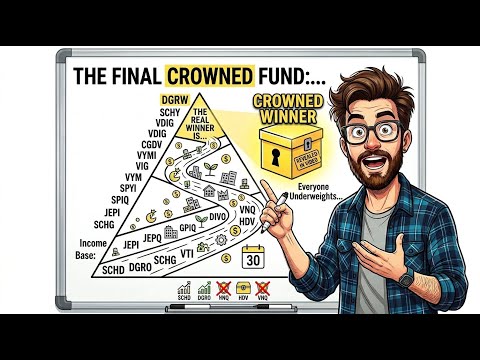
The target allocation across the three buckets:
- Now (cash / SGOV): approximately 10% of the portfolio
- Soon (SCHD + DIVO): approximately 65% of the portfolio
- Later (DGRO + VIG): approximately 25% of the portfolio
On a $600,000 portfolio: $60,000 in cash (earning roughly $2,700 per year in interest), $390,000 in the income core (generating approximately $10,800 per year in dividends), and $150,000 in the growth sleeve.
On a $750,000 portfolio: $75,000 in cash (roughly $3,300 per year), $487,000 in the income core (approximately $13,500 per year), and $187,000 in growth.
At a historical blended dividend growth rate of approximately 8.5% per year, the compounding effect is significant. A $3,000-per-month dividend paycheck could grow to approximately $6,783 per month after 10 years — on the same original capital, without adding a single new dollar. A $4,000-per-month paycheck could grow to approximately $9,044 per month over the same period. That is the yield-on-cost effect: dividends growing faster than inflation on a fixed cost basis, driven by patience rather than additional contributions.
The plan is not built on finding the one perfect ETF or timing the market correctly. It is built on giving each dollar a clear job, ordering those jobs correctly — cash to absorb the worst years, income to fund the present, growth to fund the future — and maintaining the discipline to let that structure compound undisturbed.
Watch the Full Video Walkthrough
The allocation decisions, sequence-of-returns modeling, and fund-by-fund comparisons in this article are drawn from a complete video breakdown. For a visual walkthrough of each bucket, the detailed rationale behind every fund choice, and the full 10-year projection, watch The SECURE Dividend Plan I'd Build If I Were Retiring at 60 on YouTube. If this article made the path feel clearer, the video covers every step in even greater depth.
This article is for educational purposes only and does not constitute personalized financial advice. Past performance does not guarantee future results. Consult a qualified financial professional before making investment decisions specific to your situation.