- Key Takeaways
- The 2026 Zero Percent Bracket: Where Tax-Free Dividend Income Starts
- Stacking the Standard Deduction and the Age-65 Bonus
- The Social Security Trap Most Retirees Miss
- Qualified vs. Ordinary Dividends: The Distinction That Decides Everything
- The Net Investment Income Tax and Marital Status Shifts
- Locking In Tax-Free Income: State Taxes, Account Placement, and RMDs
- Watch the Full Breakdown
- Frequently Asked Questions
In 2026, a married couple can legally collect $134,400 in qualified dividend income and owe zero dollars in federal tax. It sounds like a loophole, but it is written directly into the tax code through the interaction of the standard deduction, the age-65 bonus deduction, and the 0% qualified dividend bracket. The catch is that this tax-free ceiling only holds if you understand exactly which dividends qualify, how Social Security taxation reacts to it, and where you hold each type of income. Change one fund or overlook one calculation, and that zero can disappear fast.
This guide walks through the complete 2026 tax-free dividend framework: the exact income ceilings for singles and couples, the traps that quietly break them, and the placement strategies that lock the income in for good.
Key Takeaways
- A married couple, both age 65+, can collect up to $134,400 in qualified dividends tax-free in 2026; a single filer's ceiling is about $67,600.
- The 0% bracket applies only to qualified dividends and long-term capital gains, not ordinary dividends or interest income.
- Qualified dividends still count toward provisional income, which can push Social Security benefits into taxation even though the dividends themselves are untaxed.
- High-distribution covered-call funds like JEPI often pay ordinary income, not qualified dividends, which can cost thousands of dollars a year compared to funds like SCHD.
- Required minimum distributions (RMDs) in your seventies can push previously tax-free dividends above the ceiling and simultaneously trigger Social Security taxation.
- State tax rules, account placement (Roth vs. taxable vs. traditional), and Treasury-fund income like SGOV each follow separate rules that must be planned for individually.
The 2026 Zero Percent Bracket: Where Tax-Free Dividend Income Starts
The foundation of tax-free dividend income is the 0% federal tax rate on qualified dividends and long-term capital gains. This is not a low rate — it is written directly into the tax code as the bottom rung of the capital gains ladder. In 2026, a married couple filing jointly with taxable income at or below $98,900 pays zero federal tax on qualified dividends within that space. For a single filer, the threshold is $49,450.
These figures are adjusted for inflation every year, meaning last year's numbers are already outdated. It's also worth noting the bracket is not a cliff: income above the threshold is taxed at 15% only on the amount exceeding the line, while everything underneath remains at 0%. The strategy, then, is to fill the zero bracket as close to the ceiling as possible without going over.
Stacking the Standard Deduction and the Age-65 Bonus
The $98,900 figure is not the whole picture. The standard deduction sits underneath the zero bracket, shielding income before the brackets even begin counting. In 2026, the standard deduction is $32,200 for married couples and $16,100 for single filers. Stack that under the zero bracket, and a couple's tax-free ceiling already exceeds $130,000 before accounting for age.
Once a filer turns 65, an additional standard deduction applies: $1,650 per spouse for married couples, or $2,050 for single filers. For a couple where both spouses are 65 or older, that adds $3,300 to the deduction tower.
Stacking all three layers for a couple both age 65+:
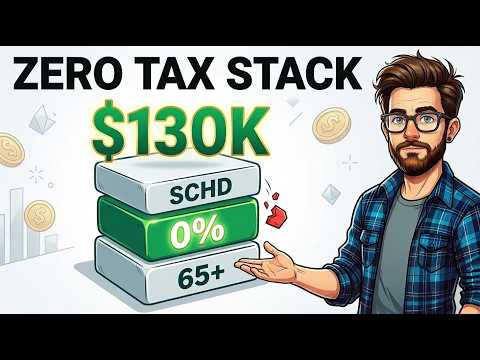
$32,200 (standard deduction) + $3,300 (age-65 bonus) + $98,900 (0% qualified dividend bracket) = $134,400 in tax-free qualified dividend income
For a single filer 65 or older, the same stack lands at roughly $67,600. There is also a temporary senior deduction of up to $6,000 per person available through 2028, which can push a couple's ceiling toward $146,000, though it phases out at higher incomes and shouldn't be relied on as a permanent planning figure.
To put the portfolio size in perspective: generating $134,400 in qualified dividends from a fund yielding around 3%, similar to SCHD, would require a portfolio of roughly $3.5 million to $4.5 million. Most retirees will never fill the entire ceiling — a $700,000 portfolio yielding 3% generates about $21,000 in dividends, comfortably tax-free with substantial headroom to spare.
The Social Security Trap Most Retirees Miss
Qualified dividends taxed at 0% still count in full toward provisional income, the calculation that determines how much of a retiree's Social Security benefit becomes taxable. This creates a scenario where dividends remain untaxed on their own, but push Social Security benefits into taxable territory.
The provisional income thresholds are strikingly low: for a couple, benefits begin becoming taxable once provisional income crosses $32,000, and up to 85% of benefits can become taxable above $44,000. These thresholds have not been adjusted for inflation since the 1980s, meaning more retirees cross them every year simply because portfolios and dividend income have grown, not because they've gotten wealthier by any meaningful measure.
Consider a couple collecting $50,000 in Social Security with no other income — none of it taxed. Add $70,000 in qualified dividends, and while the dividends still sit in the 0% bracket, the added provisional income can pull up to 85% of their Social Security into taxable income. Managing the timing of withdrawals across years, rather than taking consistent income annually, can help retirees avoid tripping these frozen thresholds repeatedly.
Qualified vs. Ordinary Dividends: The Distinction That Decides Everything
Every tax-free calculation discussed applies only to qualified dividends — dividends paid on real corporate profits by companies held for a sufficient holding period. Funds like SCHD, VIG, and VOO generally pay qualified dividends because they hold traditional dividend-paying companies.
Covered-call funds like JEPI operate differently. Much of their distribution comes from selling options contracts rather than corporate profits, and the tax code treats that income as ordinary income — taxed like a paycheck, with none of it eligible for the 0% rate. A retiree filling their portfolio with high-distribution funds under the assumption of tax-free income can end up with an unexpected ordinary income tax bill.
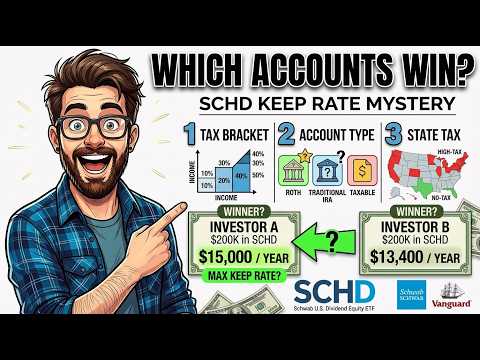
The dollar impact is significant. Two retirees each collecting $40,000 in annual income: one holding qualified dividend funds pays zero tax and keeps the full $40,000. The other, holding ordinary-income distribution funds, might lose $4,000 to $9,000 depending on their bracket — the same income, wildly different after-tax outcomes. Before buying any high-yield income fund, verify whether its distributions are classified as qualified dividends or ordinary income.
The Net Investment Income Tax and Marital Status Shifts
Higher earners should also be aware of the Net Investment Income Tax (NIIT), a 3.8% surtax on investment income once modified income exceeds $250,000 for a couple or $200,000 for a single filer. Like the Social Security thresholds, these figures are frozen and don't adjust for inflation, meaning more investors drift into this surtax over time purely from portfolio growth.
It's also worth planning for what happens when one spouse passes away. The survivor typically shifts from married filing jointly brackets to single filer brackets, often the very next tax year — cutting the tax-free ceiling nearly in half even if income stays the same.
Locking In Tax-Free Income: State Taxes, Account Placement, and RMDs
Federal tax-free status doesn't guarantee state tax-free status. Most states with an income tax treat qualified dividends as ordinary income with no equivalent 0% bracket, while states like Florida, Texas, Tennessee, Nevada, and Washington have no income tax at all.
Account placement also matters. A Roth account keeps dividend income untaxed permanently, regardless of future income levels — useful insurance against required minimum distributions (RMDs) later pushing income above the ceiling. Traditional retirement accounts defer tax but generate ordinary income upon withdrawal, which can crowd out the 0% bracket for dividends held elsewhere.
RMDs starting in your seventies are one of the biggest threats to a previously tax-free plan. Forced withdrawals count as ordinary income, stacking underneath dividends and pushing them above the ceiling into the 15% bracket — while simultaneously increasing provisional income and triggering Social Security taxation. Some retirees proactively convert portions of traditional accounts to Roth accounts during lower-income years before RMDs begin, shrinking future forced withdrawals and their downstream tax effects.
Finally, cash parked in short-term Treasury funds like SGOV pays interest, not dividends — taxed as ordinary income federally, but generally exempt from state and local tax. This is the mirror image of qualified dividends, which can be federally tax-free but state-taxable. Matching each income type to the account and location where it's treated best is central to keeping the overall plan tax-free.
Watch the Full Breakdown
This article summarizes the twelve-move framework behind the 2026 tax-free dividend ceiling, but seeing the numbers stacked step by step makes the concept far easier to apply to your own accounts. For a full visual walkthrough of how the standard deduction, the zero-percent bracket, and the age-65 bonus combine — plus the Social Security and fund-selection traps in detail — watch the complete video breakdown on the Harry's Financial Fitness channel.
For readers building out a broader qualified-dividend portfolio, the 4-ETF dividend ladder strategy offers a practical framework for combining qualified-dividend funds across different yield and growth profiles.
Frequently Asked Questions
How much dividend income is tax-free in 2026?
A married couple where both spouses are 65 or older can collect up to $134,400 in qualified dividend income tax-free at the federal level in 2026. A single filer age 65 or older has a ceiling of about $67,600. These figures come from stacking the standard deduction, the age-65 bonus deduction, and the 0% qualified dividend tax bracket.
Do dividends affect how much of my Social Security is taxed?
Yes. Even though qualified dividends can be taxed at 0%, they still count in full toward provisional income, the calculation used to determine how much of your Social Security benefit becomes taxable. This means tax-free dividends can indirectly cause more of your Social Security benefit to be taxed.
Are all dividends eligible for the 0% tax rate?
No. Only qualified dividends, generally paid by regular companies on corporate profits and held for a sufficient period, are eligible for the 0% to 15% preferential rates. Distributions from certain funds, such as covered-call ETFs like JEPI, are often classified as ordinary income and taxed at regular income tax rates instead.
Does required minimum distribution (RMD) income affect tax-free dividends?
Yes. RMDs are taxed as ordinary income and stack underneath qualified dividends in the tax calculation, which can push previously tax-free dividends above the 0% bracket ceiling into the 15% bracket, and can also increase Social Security taxation at the same time.
Is dividend income tax-free at the state level too?
Not necessarily. Most states with an income tax treat qualified dividends as ordinary income with no equivalent to the federal 0% bracket. Only a handful of states, including Florida, Texas, Tennessee, Nevada, and Washington, have no state income tax at all, allowing dividend income to remain untaxed at both the federal and state level.