A retired couple filing jointly in 2026 can earn up to $98,900 of taxable income and pay zero federal tax on qualified dividends — yet most dividend investors never use that bracket because they put the wrong funds in the wrong accounts. This fifteen-step playbook maps every move available to a US dividend investor approaching or in retirement, from account architecture to fund selection to sequencing decisions that can eliminate thousands of dollars in annual tax liability.
- The zero percent qualified dividend bracket shelters up to $98,900 of taxable income for married couples filing jointly in 2026; single filers get up to $49,450.
- JEPI and JEPQ generate primarily ordinary income and cost investors up to $1,920 per year in avoidable federal tax when held in a taxable brokerage.
- The HSA is the only account in the US tax code with triple tax protection: deductible contributions, tax-free growth, and tax-free qualified medical withdrawals.
- International dividend ETFs like SCHY and VYMI belong in taxable accounts — placing them in an IRA forfeits the Foreign Tax Credit worth roughly 60 basis points annually.
- The Roth conversion window between retirement and RMD age (now 73 under SECURE 2.0) can save $24,000 to $74,000 in cumulative federal tax compared to doing nothing.
- IRMAA Medicare premium cliffs are step functions, not slopes — just $2 of excess income above the $109,000 single-filer threshold triggers $974 in additional annual premiums.
The Five Account Decisions That Determine Where Dividends Live
Account location — not fund selection — is the primary lever for tax-efficient dividend income. The same SCHD position can produce $3,500 of tax-free income or generate an $840 tax bill depending solely on which wrapper holds it. The playbook builds outward from five account types.
Roth IRA: The Only Permanent Zero
The Roth IRA is the only account in the US tax code where qualified dividends, interest, and capital gains all compound at zero percent indefinitely. In 2026, the contribution limit is $7,500 for investors under 50, and $8,600 for those 50 and older — the catch-up amount increased from a flat $1,000 after SECURE 2.0 indexed it to inflation. A married couple where both spouses are 50-plus can contribute $17,200 annually into Roth space before factoring in 401(k) deferrals.
Direct contributions phase out for married filers between $242,000 and $252,000 of modified adjusted gross income, and for single filers between $153,000 and $168,000. Above those thresholds, the backdoor Roth preserves access. Once a dollar enters a Roth, every dividend it earns for the next four decades is permanently sheltered. An investor who maxed a Roth starting at age 30 would accumulate roughly $600,000 over thirty years at 6% growth. At a 3.5% qualified dividend yield, that generates $21,000 annually — income the IRS never sees. The same $600,000 held in a taxable account at the 24% bracket loses $5,040 per year to dividend taxes, totaling more than $100,800 over a twenty-year retirement.
Traditional IRA: Bracket Arbitrage Between Now and Retirement
The Traditional IRA works on the opposite mechanic: a deduction today, ordinary income tax at withdrawal. The strategy pays off when two conditions hold simultaneously — a high bracket while working and a lower bracket in retirement. A 32% bracket investor who contributes $7,500 saves $2,400 this year; if that money comes out at the 22% bracket in retirement, the effective cost is $1,650 — a $750 annual spread per account in the investor's favor. The same $8,600 catch-up contribution applies for those 50-plus. The Traditional IRA does not offer permanent tax freedom, but it offers bracket arbitrage between the working version of the investor and the retired version.
Taxable Brokerage: Underrated for Retirees in the Right Bracket
The taxable brokerage is widely treated as the account of last resort, but that framing misses a critical feature of the 2026 tax code. A retired couple living on Social Security plus qualified dividends, claiming the standard deduction with no earned income, can receive most of their dividend income completely free of federal tax under the zero percent qualified dividend rate. The 15% rate applies above $98,900 for couples and above $49,450 for single filers, running to $613,700 for couples before the 20% rate begins. Most retired dividend investors never reach the 15% line.
The taxable brokerage also enables tax-loss harvesting. When a position falls, the investor can sell to lock in a loss, offset capital gains elsewhere, and apply up to $3,000 of remaining losses against ordinary income annually. Switching from VYM to SCHD — two distinct ETFs with different underlying holdings — typically clears the wash sale rule while maintaining similar market exposure. Losses carried forward from prior years can shelter dividend gains for multiple future tax years.
HSA: The Triple-Protected Account Most Guides Skip
The Health Savings Account is the only account structure in the US tax code offering protection on all three sides: tax-deductible contributions, tax-free investment growth, and tax-free withdrawals for qualified medical expenses. In 2026, the self-only contribution limit is $4,400, the family limit is $8,750, and the age 55-plus catch-up adds $1,000. A family with one spouse over 55 can contribute $9,750 annually into triple-sheltered space. After age 65, the non-medical withdrawal penalty disappears and the HSA functions like a Traditional IRA for non-medical expenses — ordinary income tax applies but no penalty. Medical withdrawals remain tax-free at any age. A retiree who maxes the family HSA from age 45 to 65 at $9,750 annually, compounding at 6%, accumulates approximately $360,000 in triple-protected savings.
Backdoor and Mega Backdoor Roth: Access Above the Income Limit
Investors whose income exceeds the Roth phase-out thresholds can still access Roth space through the backdoor Roth: contribute $7,500 as non-deductible dollars to a Traditional IRA, then convert immediately to a Roth. IRS Form 8606 tracks the non-deductible basis, and tax applies only to growth between contribution and conversion — typically negligible. The pro-rata rule requires careful planning if other pre-tax IRA balances exist; rolling those into an employer's 401(k) before executing the backdoor resolves the issue. The Mega Backdoor Roth scales further. If an employer plan allows after-tax contributions above the standard deferral, investors can fund up to the 2026 defined contribution limit of $72,000 ($80,000 for those 50-plus) with after-tax dollars and convert the excess to Roth. For workers aged 60 to 63, SECURE 2.0 introduced a super catch-up of $11,250, raising the deferral to $35,750 for those four years — a window unavailable to any other age group.
The Seven Fund Classes and Where Each One Belongs
Fund selection and account location are two separate decisions that most investors conflate. The account location matrix requires classifying every holding into one of seven tax categories before assigning it a home. For a practical look at how these ETFs can be layered into a portfolio, see the 4-ETF Dividend Ladder breakdown for one approach to structuring these positions.
Qualified Dividend Funds: SCHD, VYM, DGRO, VIG, NOBL
These five ETFs have historically classified close to 100% of their distributions as qualified dividends, taxed at the zero, 15%, or 20% capital gains rates. Always verify the current year breakdown from the issuer's tax center, as portfolio changes can shift the qualified percentage. On a $100,000 SCHD position at a 3.5% yield, the annual tax difference between a retiree in the zero percent bracket and one at the 32% ordinary income rate exceeds $1,100 — from a single position. Qualified dividend funds belong in a taxable brokerage for investors whose overall taxable income stays below the zero percent ceiling, or in a Roth IRA otherwise. Holding them inside a Traditional IRA wastes the qualified rate, because every Traditional IRA withdrawal eventually becomes ordinary income regardless of how the underlying fund earned its distributions.
Ordinary Income Funds: JEPI and JEPQ
The JPMorgan Equity Premium Income ETF and its Nasdaq sibling generate yield primarily through Equity Linked Notes — financial instruments that produce ordinary income rather than qualified dividends. Historically, 80 to 90% of JEPI's distributions have been classified as ordinary income on year-end 1099 forms. On a $100,000 JEPI position at an 8% gross yield, the annual after-tax income in a taxable account at the 24% bracket is $6,080. The same position inside a Roth IRA generates the full $8,000. That $1,920 annual difference compounds to $9,600 over five years and $19,200 over ten. Ordinary income funds belong in tax-sheltered accounts. The Roth is optimal; the Traditional IRA is acceptable; the taxable brokerage is the worst possible home for this fund class.
Return of Capital Funds, Bond Funds, Muni Funds, and REITs
The NEOS S&P 500 High Income ETF (SPYI) uses Section 1256 contracts — index options that automatically split gains 60% long-term and 40% short-term regardless of holding period — and a meaningful portion of its historical distributions have been classified as Return of Capital. ROC is not taxable in the year received; it reduces cost basis instead, deferring income that would otherwise be taxed at ordinary rates today into a lower long-term capital gains rate at sale. Return of Capital funds work in a Roth, a Traditional, or a taxable account provided basis records are maintained accurately — making them the most account-flexible fund class.
Bond funds like BND and TLT pay interest classified as ordinary income. A 4.5% yield on BND held in a taxable account at the 24% bracket becomes a 3.4% after-tax yield. Bond funds belong in Traditional or Roth IRAs. Municipal bond funds like MUB are the mirror image: federally tax-exempt interest under IRC Section 103 belongs exclusively in a taxable account — placing a tax-exempt fund inside an IRA wastes the exemption on income that was already sheltered. The muni break-even bracket runs around 33%.
REIT-heavy funds pay ordinary dividends. Under the Tax Cuts and Jobs Act, REIT ordinary dividends qualified for a 20% pass-through deduction under Section 199A, effectively lowering the rate to 19.2% for a 24% bracket investor. Section 199A was scheduled to expire after December 31, 2025, with legislative status unresolved as of mid-2026. Until the law is settled, the playbook treats REIT funds as ordinary income funds for account location purposes — IRAs first — with the recommendation to confirm current law with a qualified CPA.
International Dividend Funds: The Foreign Tax Credit Trap
This is the account location reversal that surprises most investors. ETFs like SCHY (Schwab International Dividend Equity) and VYMI (Vanguard International High Dividend Yield) hold stocks domiciled outside the US. Foreign governments withhold tax at the source before dividends ever reach the investor's account — Canada at 15%, Germany at approximately 25% reduced by treaty, the UK at 0%. The IRS grants US taxpayers a dollar-for-dollar Foreign Tax Credit to recover that withholding, producing a net rate close to normal US qualified dividend rates.
The trap: Roth IRAs and Traditional IRAs are classified as tax-exempt entities and cannot claim the Foreign Tax Credit. The foreign withholding still occurs at the source. The credit simply disappears. On a 4% international dividend yield with 15% average foreign withholding, that is approximately 60 basis points per year, lost permanently with no recovery mechanism. International dividend funds belong in taxable accounts — not IRAs, not HSAs. The Foreign Tax Credit is protected only in the account where the investor can personally claim it on their own tax return.
The Roth Conversion Window and Critical Sequencing Decisions
SECURE 2.0 moved the Required Minimum Distribution age to 73 for anyone born between January 1, 1951 and December 31, 1959, and to 75 for those born after December 31, 1959 (effective 2033). That shift creates a multi-year window between retirement and the first forced RMD — a period where a retiree with no earned income controls their taxable income almost entirely.
Consider a single retiree who retires at 62, delays Social Security to 70, and draws living expenses from cash. With $10,000 in taxable dividends and the 2026 standard deduction of approximately $15,700, taxable income before any conversion sits around $14,300 — well inside the 12% bracket. A $50,000 Roth conversion that year brings total taxable income to roughly $64,300. Approximately $34,000 of the conversion fills the remainder of the 12% bracket (which tops at $48,475 for a single filer in 2026) at about $4,100 in federal tax. The remaining $16,000 falls into the 22% bracket at about $3,482. Total federal tax on the $50,000 conversion: approximately $7,583, an effective rate of 15.2%.
Ten years of $50,000 Roth conversions during the gap years costs roughly $76,000 in total federal tax. Ten years of forced RMDs in the bracket Social Security creates can cost $100,000 to $150,000. The conversion window is worth $24,000 to $74,000 in cumulative savings — before compounding on the tax difference.
Two additional sequencing tools complete the framework. The Qualified Charitable Distribution allows investors at RMD age to transfer up to $111,000 directly from an IRA to a qualifying 501(c)(3) in 2026 — up from $108,000 the prior year — counting toward the RMD while being excluded from gross income entirely. For a retiree who already donates $15,000 annually, routing that through a QCD rather than a standard deduction removes $15,000 from the top line of the 1040 before AGI-sensitive calculations begin. The Net Investment Income Tax (3.8% surtax on investment income above $200,000 for single filers and $250,000 for couples) and IRMAA Medicare premium surcharges create the cliff effects that make every dollar of AGI management consequential. The first 2026 IRMAA cliff sits at $109,000 of MAGI for single filers and $218,000 for couples. Crossing it by even $2 triggers an $81.20 monthly Medicare premium increase — $974 per year — arguably the steepest marginal tax rate hidden anywhere in the US system.
The Account Location Matrix: Synthesizing All Fifteen Steps
The synthesis of the full playbook is a single decision matrix. For a retiree holding multiple fund classes across multiple account types, the optimal 2026 placement is:
- Qualified dividend funds (SCHD, VYM, DGRO, VIG, NOBL): Taxable brokerage if overall taxable income stays below the zero percent qualified dividend ceiling; Roth IRA otherwise. Traditional IRA wastes the qualified rate.
- Ordinary income funds (JEPI, JEPQ): Roth IRA first, Traditional IRA second. The taxable brokerage is the worst available home for this fund class.
- Return of Capital funds (SPYI): Roth IRA, Traditional IRA, or taxable brokerage — roughly equal priority provided basis tracking is clean.
- Bond funds (BND, TLT): Traditional IRA first, Roth IRA second. Avoid the taxable brokerage.
- Municipal bond funds (MUB): Taxable brokerage only. Holding a tax-exempt fund in any sheltered account wastes the exemption.
- REIT-heavy funds: IRAs until the Section 199A legislative question is resolved. Confirm current law with a CPA.
- International dividend funds (SCHY, VYMI): Taxable brokerage only, to preserve the Foreign Tax Credit. IRAs and HSAs both lose the credit.
Applied to a $1 million portfolio — $300,000 in SCHD, $100,000 in VYM, $200,000 in JEPI, $300,000 in BND, and $100,000 in SCHY — the difference between a naive layout and the matrix-optimized layout is $4,700 to $6,200 in annual federal dividend taxes. Sustained over twenty years and reinvested at 6%, that gap builds an additional $200,000 to $300,000 in after-tax wealth from one structural decision. For a complementary framework on organizing these holdings by time horizon, the 3-Bucket Dividend Strategy offers a practical starting structure.
Watch the Full Video Walkthrough
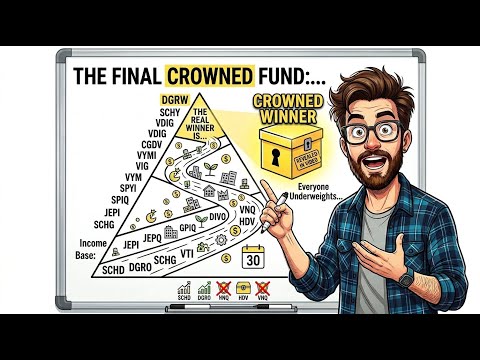
The fifteen-step framework above covers the complete playbook in written form, but the original video on the Harry's Financial Fitness YouTube channel walks through each step with worked examples, bracket comparisons, and the account location matrix built on screen. If you prefer a visual format or want to follow the full Roth conversion window projections step by step, watch the full video here. Viewers frequently cite Step 4 (the HSA triple advantage) and Step 11 (the Foreign Tax Credit trap) as the moves they had never considered before.
Disclaimer: This article is for educational purposes only and does not constitute financial or tax advice. Tax laws change, and several provisions referenced here — including Section 199A and IRMAA thresholds — may be affected by pending legislation. Always consult a licensed CPA before implementing any strategy based on this content.