- Key Takeaways
- Ordinary vs. Qualified Dividends: Why the Distinction Changes Everything
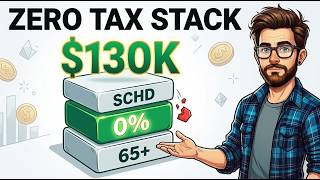
- The Zero Tax Stack: Three Layers to a $0 Federal Tax Bill
- Running the Numbers: Single Filer at 65
- The Married Couple's $134,400 Ceiling
- Three ETFs That Power the Zero Tax Stack
- What Breaks the Stack: The Trap of the Wrong Income
- Real-World Portfolio Sizes and What They Produce
- Caveats That Matter Before Building This Plan
- Watch the Full Breakdown on YouTube
Two retirees, same age, same $60,000 in annual investment income. One mails the IRS a check every April. The other owes nothing. The difference is not an offshore trick or an aggressive strategy — it is a single word on one tax form. In 2026, that word can legally shelter $134,400 of a married couple's dividend income from federal income tax, and most retirees walk past that door every year without realizing it is open.
Key Takeaways
- The IRS taxes qualified dividends at 0%, 15%, or 20% — far below ordinary income rates that can reach 37% in 2026.
- The 0% qualified-dividend bracket applies up to $98,900 of taxable income for married couples filing jointly in 2026.
- Retirees aged 65 or older receive an enhanced standard deduction — a married couple where both spouses are 65+ gets a deduction floor of $35,500 in 2026.
- Stacked together, a married couple both aged 65+ can collect up to $134,400 in qualified dividends with zero federal income tax.
- SCHD, DGRO, and NOBL are three ETFs with predominantly qualified dividend distributions — the engines of a zero-tax income portfolio.
- Covered-call funds, REITs, and bond interest are generally not qualified income and can silently collapse this entire plan.
Disclaimer: This article is educational in nature and is not financial or tax advice. Tax rules change, and the 2026 figures referenced here may be updated over time. Always consult a qualified tax professional before acting on this information.
Ordinary vs. Qualified Dividends: Why the Distinction Changes Everything
Not all dividend income is treated equally by the IRS. Every dividend dollar collected lands in one of two buckets, and the bucket determines the tax rate.
Ordinary dividends are taxed as regular income — running through the same brackets that apply to a paycheck, from 10% all the way to 37% in 2026. Qualified dividends receive a separate, preferential rate ladder: 20% at the very top of the income scale, 15% for most middle-income earners, and 0% at the bottom. That 0% rate is the same preferential treatment long-term capital gains receive. It is written directly into the tax code — not a gray area, not an aggressive strategy, not a workaround. It is the standard rule.
Brokerage firms do the sorting automatically each year. Form 1099-DIV arrives each January: Box 1a shows total ordinary dividends, and Box 1b shows the qualified portion. That single-letter distinction — 1a versus 1b — is the entire difference between the two retirees in the opening scenario.
For a dividend to be qualified, it generally must come from a U.S. corporation or a qualifying foreign company, and the investor must have held the shares for more than 60 days within a 121-day window centered on the ex-dividend date. Investors who hold broad dividend ETFs for the long term usually satisfy this holding-period test automatically. But the investment strategy inside the fund determines whether dividends are structurally qualified in the first place.
The Zero Tax Stack: Three Layers to a $0 Federal Tax Bill
A simple three-layer framework makes the math concrete. Build all three layers correctly, and the federal tax line at the bottom of a return can legitimately read zero.
Layer 1 — The Deduction Floor
The standard deduction is income the IRS never measures at all. In 2026, it is $16,100 for single filers and $32,200 for married couples filing jointly. Turn 65, and the IRS adds to that floor automatically — no special election or additional form required.
A single filer aged 65 or older receives an extra $2,050, raising the floor to $18,150. A married couple where both spouses are 65 or older receives an extra $1,650 per spouse, pushing their combined floor to $35,500. These additions are built into the tax code specifically for older Americans.
Layer 2 — The Zero Percent Band
Above the deduction floor sits the 0% qualified-dividend bracket. For 2026, the IRS set the upper boundary at $49,450 of taxable income for single filers and $98,900 for married couples filing jointly. Qualified dividend income that falls within this band is taxed at exactly zero percent — and these are taxable income thresholds, meaning the gross dividend ceiling sits higher than these numbers once the deduction floor is added on top.
Layer 3 — The Qualified Dividend Engine
The third layer is fund selection. The deduction floor and the zero-percent band only produce a zero tax bill if the income flowing into them is actually qualified. Choosing funds with consistently high qualified-dividend ratios is what makes the stack function as designed. The three funds discussed below are the engines most commonly studied for this purpose.
Running the Numbers: Single Filer at 65
Adding Layer 1 and Layer 2 together produces the gross income ceiling — the maximum in qualified dividends that can be collected before any federal tax appears.
$18,150 (deduction floor, age 65+) + $49,450 (zero percent band) = $67,600 tax-free ceiling for a single retiree in 2026.
That is more than $5,600 per month in dividend income, with a federal tax bill of zero. Consider a retiree collecting $60,000 in annual qualified dividends: after the $18,150 deduction, taxable income falls to roughly $41,850 — well inside the zero percent band. The entire $60,000 passes through untouched by federal income tax. That is the second retiree from the opening — same income as the first, completely different outcome.
The Married Couple's $134,400 Ceiling
The numbers expand substantially for married couples, and this is where the headline figure comes from.
$35,500 (joint deduction floor, both spouses aged 65+) + $98,900 (zero percent band, married filing jointly) = $134,400 tax-free ceiling for a married couple in 2026.
A retired couple could collect $134,400 in qualified dividends — roughly $11,200 per month — and under this exact fact pattern, owe zero in federal income tax. Their taxable income after the deduction would be $98,900, sitting precisely at the top of the zero percent band. Every dollar inside it is taxed at nothing. Not reduced. Not deferred. Zero.
Current law also includes a temporary bonus deduction of up to $6,000 per taxpayer aged 65 or older, available through 2028. This provision phases out above $75,000 of modified adjusted gross income for singles and $150,000 for couples. For those who qualify fully, it could stretch a single retiree's ceiling to approximately $73,600 and a couple's to roughly $146,400. Treat those as potential ceilings, not guarantees — the core figures of $67,600 for singles and $134,400 for couples are the numbers to anchor on.
Three ETFs That Power the Zero Tax Stack
The qualified dividend engine is where fund selection makes or breaks the strategy. Three ETFs are widely studied for their historically high qualified-dividend ratios. For a detailed comparison of how two of these funds have performed over time, see this breakdown of DGRO vs. SCHD dividend growth.
SCHD — Schwab U.S. Dividend Equity ETF
SCHD is the anchor of this approach. It holds approximately 100 large, established, cash-rich U.S. companies — precisely the type whose payouts tend to qualify for the preferential rate. Historically, SCHD's dividends have been almost entirely qualified, year after year. The fund currently yields around 3.25%, carries a 0.06% expense ratio, and its dividend has grown at roughly 9% annually over the past five years. The income is not only tax-efficient — it has historically increased each year investors held the fund.
DGRO — iShares Core Dividend Growth ETF
DGRO carries a lower current yield of approximately 1.9% and a 0.08% expense ratio. Its inclusion in the stack rests on two grounds: dividend growth of roughly 7% annually over the past five years, and exceptional tax efficiency. For the 2025 tax year, iShares' own tax reporting designated 100% of DGRO's distributions as qualified dividend income — every dollar eligible for the 0% rate. For a retiree building a zero-tax income floor, that is an ideal profile.
NOBL — ProShares S&P 500 Dividend Aristocrats ETF
NOBL holds only companies that have raised their dividends for at least 25 consecutive years — 69 companies currently. This is a discipline screen, not a yield screen. The fund yields just over 2%, with an expense ratio of 0.35%. One honest caveat: NOBL can hold a small number of positions — certain real estate companies, for example — whose payouts are not fully qualified. The fund's annual tax report reveals the actual qualified percentage each year. Its primary role in the stack is stability: proven payers that have continued raising dividends through every kind of market environment.
For investors building a structured multi-fund retirement income portfolio, the 3-Bucket Dividend Strategy using NOBL and SCHD offers a complementary framework worth reviewing alongside this approach.
What Breaks the Stack: The Trap of the Wrong Income
The zero-tax strategy is real, but it is fragile in one specific way: it only works with qualified income. High-yield products that generate the same dollar amounts in a different tax character can silently invalidate the entire plan.
Covered-call funds and option-income ETFs are the most common trap. These products can advertise distribution rates of 8% to 9%, and they can genuinely serve a purpose for investors prioritizing current income. But a significant portion of what they distribute is option premium — taxed as ordinary income — along with short-term gains and return of capital. Very little of it may be classified as qualified. Running a six-figure income stream through ordinary income brackets instead of the zero percent band produces a very real tax bill where there could have been none. Same dollars coming in. Wildly different dollars kept.
REIT dividends and bond interest carry the same warning. Both represent legitimate income sources with their own role in diversified portfolios, but neither is generally qualified dividend income. Both burn through the deduction floor and then get taxed at regular rates. Mixing these sources into a zero-tax plan without accounting for their impact is what converts the second retiree back into the first — the one writing checks to the IRS each spring.
Real-World Portfolio Sizes and What They Produce
A blended 60/20/20 allocation — 60% SCHD, 20% DGRO, 20% NOBL — produces a weighted yield of approximately 2.7% at current rates. Here is what that translates to across several portfolio sizes:
- $500,000 portfolio: approximately $13,500 per year ($1,125/month) — comfortably below every threshold discussed
- $1,000,000 portfolio: approximately $27,000 per year — zero federal tax for a single or married retiree at 65
- $2,000,000 portfolio: approximately $54,000 per year — a single 65-year-old retiree still falls under the $67,600 ceiling
For a married couple to reach their $134,400 ceiling with this blend, they would need close to $5 million invested. The vast majority of retired couples living on a qualified dividend portfolio fall entirely within the zero percent zone. The ceiling is not the binding constraint — awareness that it exists is.
Caveats That Matter Before Building This Plan
The math above assumes qualified dividends are essentially the only taxable income source. Real retirements are more complex. Several factors can shift the outcome significantly:
- Other ordinary income — pensions, part-time earnings, traditional IRA withdrawals, and Roth conversions all fill the deduction floor and brackets first, potentially pushing dividend income up into the 15% rate.
- Social Security — dividend income counts in the separate formula that determines how much of Social Security becomes taxable, even when the dividends themselves owe no tax. This is its own calculation with its own thresholds.
- Account type — this strategy applies to taxable brokerage accounts. Money coming out of a traditional IRA or 401(k) is ordinary income upon withdrawal, regardless of the underlying fund or what it holds.
- State taxes — many states apply their own income tax rules to dividends without any preferential rate. All figures in this article are federal only.
- Future rule changes — these are 2026 federal figures. Brackets adjust annually for inflation, and Congress can alter the preferential rate structure. Verify current numbers before building a plan around them.
A qualified tax professional can map all of these variables onto a specific situation — this framework is a starting point for understanding, not a final plan.
Watch the Full Breakdown on YouTube
For a visual walkthrough of the Zero Tax Stack — including the exact deduction math for both singles and married couples, a fund-by-fund tax character analysis, and real-time calculations across multiple portfolio sizes — watch the full video. It also covers the temporary bonus deduction available through 2028 and walks through exactly how the wrong kind of high-yield income can unravel an otherwise sound plan.
Watch: At 65, $130,000 of Dividend Income Can Be Completely Tax-Free