The average dividend fund investor pockets 1.2 percentage points less per year than the fund they own — same fund, same market, same decade. That gap is not caused by bad fund selection. It is caused by behavior. Two investors can buy the identical dividend ETF on the same day, and a decade later one retires on it while the other exits at the worst possible moment. The fund never failed them. Their habits did.
Key Takeaways
- A 1.2 percentage-point annual behavior gap compounds into tens of thousands of dollars in lost retirement income over 30 years.
- Fund selection accounts for roughly a quarter of dividend investing outcomes — behavior drives the rest.
- Total return and dividend growth reliably outperform high headline yields over long time horizons.
- Missing just the 10 best trading days across 40 years can cut a portfolio's ending value by more than half.
- Constant portfolio tinkering is one of the largest documented destroyers of long-term investor returns.
- Every one of the 12 habits below is a form of patience wearing a different costume.
The dividend investors who actually reach a comfortable retirement are almost never the ones who picked the cleverest fund. They are the patient ones — investors who did a handful of unglamorous things, repeatedly, for years, then simply got out of their own way. The following 12 habits, illustrated using funds like SCHD, VIG, DGRO, NOBL, VYM, and VOO as examples, make the difference between a dividend investor who wins and one who never quite gets there.
This article is for educational purposes only and is not financial advice. All data is historical and illustrative. Past performance does not guarantee future results. Always conduct your own research before making any investment decisions.
Why Behavior, Not Fund Selection, Decides Who Wins
Fund picking dominates financial headlines, but the research consistently tells a different story. The behavior gap — the difference between what a fund earns and what the investor inside that fund actually keeps — shows up reliably across fund categories and market cycles. Most of that gap comes from predictable, avoidable mistakes: selling during crashes, chasing recent top performers, over-trading, and abandoning a strategy the moment it stops feeling exciting. Understanding this reality is the foundation every serious dividend investor needs before evaluating a single fund.
The Four Foundation Habits
These four habits form the base layer of patient dividend investing. Everything else builds on them.
Habit 1: Choose Total Return Over Headline Yield
A fund advertising a yield near 9% looks like a gift. A quality fund like SCHD, yielding around 3.2% but screened for companies strong enough to keep raising their payout, looks unimpressive by comparison. But headline yield and total return are very different things. High yields are often high because the price fell — and prices fall when the market senses trouble. A 9% yield that gets cut in half two years later leaves an investor with less income and a lower share price simultaneously, the worst of both outcomes. Meanwhile, a quality grower that has raised its dividend roughly 9% per year over the last five years is quietly compounding a larger check with every passing year. The tortoise does not just catch the hare on income over a decade. It laps it. The size of today's check matters far less than whether that check survives and grows.
Habit 2: Keep Costs Nearly Invisible
Every dollar paid in fees is a dollar that never compounds. SCHD charges approximately 0.06% — six cents per year on every $100 invested. A fund charging a full 1% costs over sixteen times as much. On a meaningful nest egg across 30 years, that difference is not a rounding error. It runs to tens of thousands of dollars quietly siphoned from the portfolio through compounding working in reverse. Cost is the one variable in this entire game that an investor fully controls, with no market required. Picking the low-cost fund on day one and never revisiting that decision is patience doing its quietest, most powerful work.
Habit 3: Own a Broad Basket, Not a Handful of Names
Funds like VYM, which spreads across a large number of high-dividend companies, or DGRO, which holds hundreds of dividend growers, ensure that no single dividend cut can materially damage a retirement income stream. When income depends on hundreds of companies, one troubled holding becomes a rounding error. The remaining positions keep paying — many keep raising — and the portfolio barely registers the disruption. Breadth is not about chasing more return. It is about buying the calm required to stay patient when any single holding stumbles, because no individual company can force a panicked decision.
Habit 4: Reinvest Dividends on a Schedule and Leave It Alone
Before retirement income is actually needed, every dividend that lands should buy more shares — automatically, without requiring a fresh decision each quarter. The difference between an investor who reinvests and one who takes dividends as cash is nearly invisible for the first year or two. Then it compounds. Each reinvested dividend buys more shares. Those shares generate their own dividends. Those dividends buy still more shares. By decade two and three, the reinvestor owns dramatically more shares than they ever purchased, each paying its own growing dividend. The cash taker still holds roughly what they started with. Same fund, same starting money, vastly different ending — decided by a single toggle and the discipline to leave it switched on.
The Habits Nobody Actually Keeps When Markets Turn
The next four habits are where most investors quietly lose the game. They are not complicated. They simply require staying still when every instinct says to act.
Habit 5: Hold Straight Through a Crash Without Selling
This is the single most valuable behavior on the entire list, and the one investors fail at most consistently when it matters. Consider this illustration: $10,000 invested in the broad market and left completely untouched across roughly four decades grew to over $1 million. An investor who did everything identically — except missed just the 10 best trading days across those 40 years — ended up with less than half a million dollars. Less than half, from missing only 10 days in four decades.
The particularly cruel detail is that those 10 best days cluster directly inside the worst periods. The biggest up days and biggest down days are neighbors in time. An investor who sells to escape the panic almost guarantees they also miss the recovery, because the recovery begins before it ever feels safe to re-enter. Quality dividend funds, meanwhile, mostly kept paying distributions straight through past downturns. The dividends kept landing for whoever was patient enough to still be holding. The crash is not the danger. Selling into the crash is the danger.
Habit 6: Expect the Dividend Check to Wobble Quarter to Quarter
Even the most disciplined dividend funds pay uneven amounts from quarter to quarter, because underlying companies pay on different schedules in different sizes, and the fund passes through what it collects. NOBL holds only companies that have raised their dividends for 25 consecutive years or more — approximately 69 businesses that have kept that promise through multiple recessions. Yet even this fund pays irregular amounts from one quarter to the next. A lighter distribution is almost never a cut. It is the natural rhythm of cash flow. Patient investors measure the trend across a full year, not a 12-week snapshot, and never let one wobbly quarter override a decades-long track record.
Habit 7: Never Chase Last Year's Top Performer
Performance chasing accounts for a significant portion of the behavior gap. The pattern is predictable: a flashy fund posts an eye-catching number, an investor sells their steady holding to buy the recent star — usually right as its hot streak ends. Each confident, impatient switch locks in two mistakes in a single move: selling relatively low on the abandoned fund and buying relatively high on the chased one. Done a few times across a 30-year investing life, that pattern quietly destroys a genuine fortune. Last year's leaderboard is not a shopping list. It is a trap dressed as an opportunity.
Habit 8: Stop Tinkering With a Portfolio That Is Already Working
Daily account checks, small allocation nudges, and tactical tweaks feel like diligence. The research says otherwise. When investors are sorted by trading frequency, the pattern is nearly mechanical: those who trade the least tend to capture the most of what their funds actually earn. Every extra transaction is another chance to buy slightly too high and sell slightly too low. Every decision made under stress is a decision made when human judgment is at its worst. On a serious nest egg, a behavioral drag of even one percentage point per year — compounded across a 30-year retirement — is not a rounding error. It is years of extra income, spent one productive-feeling trade at a time. Doing less is a real strategy, and it is usually the winning one.
The real cost of interrupting a dividend strategy is examined closely in the article on pausing dividend ETFs for six months and the $13,900 consequence.
The Four Habits That Decide the Final Outcome
These final four habits separate the investor who merely survives from the one who retires comfortably on dividends and stays retired.
Habit 9: Prize Dividend Growth Over Dividend Size
A smaller yield that climbs every year will, given enough time, bury a larger yield that sits flat. VIG has grown its dividend approximately 9% per year over the last five years. VYM has grown its payout closer to 3.8% per year over the same stretch. On day one, VYM hands investors more cash — its yield sits around 2.3% against VIG's roughly 1.5% — so staring only at the starting number, VYM looks like the obvious choice. But a dividend compounding at 9% per year roughly doubles in about eight years. A dividend growing at under 4% per year takes closer to 20 years to do the same. The fund that paid less on day one climbs far faster underneath, and eventually its check crosses over and keeps pulling away. Yield describes today. Growth describes the next 20 years — and for a long retirement, the next 20 years is the entire game.
Habit 10: Match the Tool to the Actual Job
There is no single perfect dividend holding, only holdings that fit a specific purpose. DGRO, built as a broad dividend grower holding hundreds of companies, is engineered for patient long-term compounding. VOO, the broad market index, is built to grow the total portfolio at minimal cost — it yields near 1% because income is not its assignment. Neither fund fails when it does not perform the other's work. The mistake is expecting a low-yielding growth engine to fund current income, or expecting a dividend income fund to keep pace with a roaring growth market in its best years. Assigning each holding a clear role — income foundation, long-term growth engine, ballast — and judging each only against that role is how a well-constructed portfolio stays coherent through every market cycle.
Habit 11: Refuse to Let Short-Term Emotion Override a Long-Term Plan
This is the precise moment where two identical investors split into a winner and a quitter. Two investors buy the same quality dividend fund on the same day. A brutal bear market arrives. The quitter sells to stop the pain, intending to re-enter when it feels safer. It never feels safe at the bottom. The recovery begins while they are frozen in cash, and by the time re-entry seems justified, the fund has already climbed back. They buy back in higher than they sold — if they ever return at all.
The winner holds the same fund, lets dividends keep landing and reinvesting through the fear, and trusts the plan made during a calm period — precisely because it was made when emotions were not running the analysis. When the recovery comes, they are fully invested for every day of it. Same fund, same starting money, same market. One retired comfortably. The other locked in a loss from a decision that took one frightened afternoon to make. The plan made in calm is the only thing powerful enough to override fear in panic. Write it down and defend it when it arrives.
Habit 12: Give Compounding Enough Time to Actually Work
Every habit on this list is ultimately a way of protecting time. Choosing total return prevents compounding from being interrupted by cuts. Keeping costs low stops time from leaking money. Holding through crashes preserves years of future growth. Reinvesting lets each year build on the last. Prizing dividend growth accelerates the curve. All of it exists to protect one thing: enough uninterrupted years to reach the steep part of the compounding curve, where the snowball stops crawling and starts to sprint.
Compounding is almost insultingly boring for a long time. The dividend check grows around 9% per year, the balance creeps upward, and nothing dramatic happens. This is exactly the stretch where impatient investors give up and chase something with a faster story. But the early years are the price of admission, and the late years are the reward — and almost all of the reward lives in the late years. The same dividend growth that felt invisible in year three is generating large, snowballing income by year 25, because now it is compounding on a base that has quietly grown enormous. The investor who quit in year eight never saw it. The investor who stayed got the whole payoff.
If that feeling of stagnation before compounding accelerates sounds familiar, the article on why investors quit right before compounding works explains the mechanics and how to push through it.
The One Pattern Running Through All 12 Habits
Every one of these habits is a form of patience wearing a different costume. Patience with a smaller yield that grows instead of a fat one that flames out. Patience with a boring low-cost fund that never makes headlines. Patience through a terrifying crash when the account is deep in the red. Patience with an uneven check that wobbles quarter to quarter. Patience while everyone around you chases the leaderboard, tinkers with a portfolio that was already working, or panics at exactly the wrong moment.
Every dollar of that 1.2-percentage-point annual behavior gap was spent on impatience — on trades that felt smart, on sales that felt safe, on switches that felt long overdue. Nobody lost that money picking a bad fund. They lost it by being human at the worst possible moments.
The funds are almost interchangeable. The behavior is everything. That is the quiet truth hiding in plain sight at the center of dividend investing — and the investors who internalize it early are the ones who actually make it to the other side.
Watch the Full Breakdown on YouTube
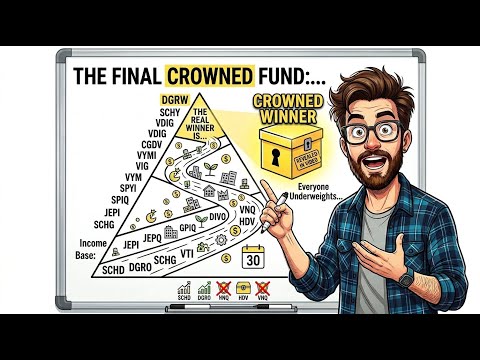
For a visual walkthrough of all 12 habits — including the side-by-side yield comparison over a full decade, the compounding curve illustrated across 25 years, and the crash-and-recovery sequence that makes the case for holding — watch the full video at the link below. The visual format makes the growth-versus-yield math especially concrete, and seeing exactly where the behavior gap originates across a real 40-year illustration is the kind of thing that sticks long after the numbers on a page have faded.