- Key Takeaways
- Why the Boring Stall Always Has the Longest Line
- Food 1: Charcuterie Boards and Grazing Cups
- Food 2: Specialty Sauce or Rub
- Food 3: Handmade Candy and Chocolate
- Food 4: Fresh Nut Butter, Ground to Order
- Food 5: Kettle Corn
- Food 6: Cotton Candy
- Food 7: Mini Donuts
- The Four-Hour Queue: What Actually Determines a Market Day's Income
- Watch the Full Breakdown
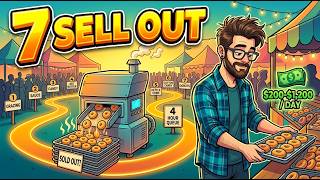
At weekend markets, the longest line is almost never at the prettiest stall. It is at the boring one with the cheap machine, filling the air with smell, gone before one o'clock. That uncomfortable observation is the starting point for one of the more useful boring business ideas in food: a short list of seven foods that reliably sell out at farmers markets, craft fairs, and street festivals, each run by a single person with no shop, no commercial kitchen, and no staff. Weekend market business is about volume and a ritual called The Four-Hour Queue — a fixed window where the smell and the show create demand, and the job ends when the window closes, whether or not there is stock left on the table.
The seven stalls below are ranked from cheapest setup to the highest-margin apex item: charcuterie boards, a jarred sauce or rub, handmade candy and chocolate, fresh nut butter, kettle corn, cotton candy, and mini donuts. Each one is a legitimate small food business idea that can be tested for a few hundred dollars before anyone quits a day job.
Key Takeaways
- A one-person charcuterie and grazing cup stall can gross $200 to $600 on a normal Saturday, and over $1,000 with grazing-table pre-orders, for under $500 in startup cost.
- Kettle corn runs an 80 to 87 percent gross margin, with established operators reporting $800 to $1,200 days and one vendor disclosing $4,500 a month.
- Cotton candy is the cheapest machine on the list (as low as $150) and the highest margin, at 94 to 96 percent gross — one operator grossed $9,000 across a three-day festival against $372 in sugar.
- Mini donuts are the apex food business without a restaurant: published figures show a 95 percent gross margin and roughly $1,135 of gross profit in a single two-hour window.
- Every category has a specific permit or filing — cottage food registration, a temporary event permit, fire code sign-off for open flame, or ventilation rules for a donut machine — that functions as the real moat against casual competition.
- Most cottage food businesses can be tested and in front of customers within two to six weeks of starting the market application process.
Why the Boring Stall Always Has the Longest Line
The pattern shows up at every market: a stall with a four-thousand-dollar setup watches a folding table with a kettle and a paddle outsell it all day. The reason is structural. A market day is a fixed window of exposure, and the stalls that win are the ones where the product makes itself in front of the customer — popcorn popping, chocolate being tempered, a donut dropper running continuously. Smell and show do the marketing for free; everything else has to be sold the hard way. That single idea underlies all seven foods covered here, and it is the first filter to apply before picking which one to test.
Food 1: Charcuterie Boards and Grazing Cups
This is the only item on the list that needs no machine at all, which makes it the lowest-friction entry into a cottage food business from home. A grazing cup sells for $10 to $15, and a small board sells for $40 to $150. A one-person stall realistically takes $200 to $600 gross on a normal Saturday, climbing past $800 at an affluent market or one that allows pre-orders. Adding two or three grazing-table pre-orders at $200 to $400 each pushes a single day past $1,000.
The margin is the real story. A $12 grazing cup costs $3 to $4 in cured meat, two cheeses, crackers, and fruit — a 65 to 75 percent gross margin on a cup that takes about ninety seconds to assemble. A vendor can move 8 to 15 cups an hour during peak windows, and pre-orders are collected in a five-minute handover that uses no floor time at all.
Startup is a folding table ($40 to $80), a cooler with ice packs, compostable cups at $0.30 to $0.60 each, and printed labels — commonly under $300 to $500 total. Most weekend markets run a seasonal application with a vendor jury reviewing product photos and a description, a $15 to $40 application fee, and a weekly booth fee of $30 to $75, or sometimes a 9 to 10 percent gross-revenue cut instead. Craft fairs and holiday markets are the easiest door in, since they skip the certified-grower bar that produce-focused farmers markets apply. The moat is a food handler card ($10 to $30), cottage food registration (free to about $75 depending on the state), and a temporary event permit tied to that specific market — enough paperwork to keep a casual home cook from setting up on a whim. Expect two to four weeks to a first market day, and cut one board open for sampling: a sealed display board sells a fraction of what an open one does.
Food 2: Specialty Sauce or Rub
A jar sells for $8 to $12 at a 55 to 70 percent margin, moving 4 to 8 bottles an hour on a slow morning and 12 to 15 once a sampling line forms. Part-time cottage food vendors report $200 to $600 a market day, established ones $400 to $800, and a known local brand with a tasting table can clear $1,000 at a festival. Startup runs $500 to $1,500 for the first batch and packaging, with a $45 to $60 weekly booth fee in the food-processor category.
Acidified and fermented sauces often require pH testing and, in some states, a process review — a genuine barrier, but one that keeps a friend-of-a-friend operation from appearing next to you the following weekend. At four to eight weeks to a first market, this is the slowest start of the seven, but it buys the strongest repeat-purchase pattern on the list: one bottle to try, then four bottles a month, indefinitely.
Food 3: Handmade Candy and Chocolate
Fudge sells at $2 to $4 a piece or $8 to $14 a gift box; bark and brittle run $6 to $12 a bag. Part-time vendors report $200 to $600 a market day, past $800 at higher-end markets, and a chocolate maker running several markets can do $1,500 to $5,000 a month. A fudge batch costs $3 to $5 in ingredients and yields 12 to 16 pieces at $2 to $4 each — frequently over 70 percent gross margin.
Jennifer Ashby runs Ashby Confections out of Scotts Valley, California, selling small-batch chocolate and candy at the downtown Santa Cruz and Aptos farmers markets, sourcing local fruit for her flavors — a real, one-person operation. Setup runs $500 to $2,000, and at the cheapest tier a double boiler replaces a dedicated tempering machine entirely.
Chocolate and fudge peak in winter, from Halloween through Christmas, making this the counter-seasonal pick against every summer festival item further down the list. Cottage food sales caps in most states run $25,000 to $150,000 a year, which is substantial headroom for a single stall. The moat is cottage food registration plus, in some states, a temperature-control exemption filing, since cream-filled chocolate sits close to the potentially-hazardous-food line. Budget one full batch per market day purely for samples — vendors consistently report that the sample is what turns a browser into a box buyer.
Food 4: Fresh Nut Butter, Ground to Order
A jar sells for $8 to $14. A stall built around a countertop grinder can generate $4,000 to $7,000 a month across market sales, jar sales, and pre-orders — roughly $250 to $440 a day at four market days a week, and considerably more at a festival where the live grind draws a crowd. The visual of nuts going in and butter coming out drives impulse buys more than price does.
A used grinder runs $800 to $2,500 against roughly $4,300 new, with a budget commercial unit available for around $250. A fully loaded first season — grinder, canopy, jars, labels, nuts, permit, and insurance — totals $2,500 to $3,500. The moat is liability insurance at roughly $300 a year, since a machine running live in public raises a market's insurance bar above a table of sealed jars. Expect four to six weeks to a first market.
Food 5: Kettle Corn
A small local market produces $200 to $480 over four hours, at 40 to 60 bags priced around $8. A medium street fair over six to eight hours does $800 to $1,200, at 100 to 150 bags. A large festival over ten to twelve hours clears $2,000 and up. Eric Bickernicks has run Velma's Wicked Delicious Kettle Corn in New England since 2006; his early farmers market days generated about $200, growing into a regular $800 to $1,000 in a single day. Separately, Katie Young of Klondike Kettle Corn disclosed $4,500 a month in revenue — around $54,000 a year on one or two markets a week.
Roughly $1 of ingredient per bag against a $5 to $8 sale is an 80 to 87 percent gross margin, with vendors deliberately pricing at a five-to-one or eight-to-one return on ingredient cost.
A full propane rig — kettle, burner, paddle, tent, and table — runs about $2,000 to $3,000, and one strong festival day can cover the whole setup. The moat is physical: an open propane flame usually needs fire code sign-off at a market or fair, on top of the standard temporary food permit and food handler card — one extra box on the application that an unprepared newcomer never ticks. Expect three to five weeks to a first market day. For anyone comparing kettle corn business profit against lower-cost categories, tracking bag count against weather, position, and price after one season removes the guesswork about which events are worth the drive.
Food 6: Cotton Candy
Cones sell for $5 to $10 depending on the event. A weekend vendor at local fairs does roughly 50 cones a day at $5, about $250 gross. An event specialist at proper festivals sells 100 to 150 cones at $6 to $8, or $900 to $1,200 gross in a day. One operator running three machines across a three-day festival sold over 1,200 cones and grossed $9,000, against $372 of sugar — a production cost of about $0.31 a cone against a $5 to $7 sale, for a 94 to 96 percent gross margin, the highest on this list.
Countertop models suitable for market work run $150 to $800, with reliable commercial units around $250; a whole market-ready setup is realistically $300 to $600, meaning one strong festival day can pay for the entire cotton candy business. The permit bar is lighter here too, because sugar floss is generally not classed as a potentially hazardous food — a food handler card and the market's standard registration is usually enough, making this the strongest first-timer category on the list. Expect two to three weeks to a first market.
Food 7: Mini Donuts
The apex of the list, and the highest margin of all seven. Running one automatic machine at full speed for two hours produces 200 dozen mini donuts; at $6 a dozen that is $1,200 of revenue against $64.36 of ingredients — a 95 percent gross margin and about $1,135 of gross profit in a two-hour window. A separate operator profiled as Mike pulls $1,000 in pure profit on a strong event day, and a four-hour Saturday evening service at a brewery cleared 800 donuts at $5 each, a $4,000 shift.
Dozens sell for $4 to $8. A machine can output up to 100 dozen an hour flat out, though one person cooking, bagging, and taking money realistically sustains 20 to 40 dozen an hour — production, not demand, is the ceiling, which is why these stalls sell out. Used machines circulate from around $2,000 up to $9,000 or $10,000 depending on condition and whether a cart is included. The moat is ventilation and power draw: some markets require a ventless model specifically, so confirming the market's power and generator rules on the application before buying a mini donut machine is the difference between a machine that earns and one sitting in a garage. Expect four to six weeks to a first market, the longest lead time of the seven.
The Four-Hour Queue: What Actually Determines a Market Day's Income
Across all seven categories, the gap between a $200 day and a $1,000 day is rarely the recipe. It is the crowd, the booth position, and the price set that morning. Three filters narrow the choice: does the product make itself in front of the customer, does the season match right now (kettle corn and cotton candy are summer; chocolate and fudge are the winter gift run), and can the stall actually sell out by early afternoon rather than packing up half full. Bringing what the last three Saturdays actually sold, pricing to the market rather than a fixed formula, and checking weather and pitch position before committing a full stock run are the practical fixes once a pattern of overstocking or underpricing shows up.
For readers comparing this against other low-capital paths, the broader category of boring businesses that make money under $500 to start covers several non-food options with similarly low startup friction, while those looking at a bigger first purchase may want to compare against the boring cash-flow machines that run on $30,000 for a sense of how equipment-heavy income scales.
Watch the Full Breakdown
Each of these seven stalls comes with per-unit margins, setup photos, and the specific permit language referenced above, all walked through visually in the original video. For anyone deciding which market stall idea to test first, watching the full breakdown adds the visual pacing — the queue forming, the machine running, the sample tray emptying — that a written summary can only describe.