- Key Takeaways
- Grazing Leases: The Easiest Way to Monetize Pasture
- Hunting and Fishing Access: Selling the Season
- Standing Timber: The Crop That Grew Itself
- Event Parking and Truck Yards: Renting the Gravel
- Solar Leases and Underground Royalties: The Highest Ceilings
- Avoiding the Handshake Mistake
- Watch the Full Breakdown
- Frequently Asked Questions
An empty field can collect a monthly check without a single structure ever going up on it. No house, no storage units, no barn — just a signature on a lease. Most land advice pushes owners toward building something: pour a slab, put up units, borrow against the deed and hope. That approach gets it backwards. Across the country, landowners are earning steady income from raw, unimproved acreage simply by leasing what is already there — the grass, the gravel, the timber, the sunlight, or the empty space between fence posts.
In Montrose County, Colorado, a public lease record shows a landowner collecting $2,000 a year flat, plus $1.61 for every ton of crushed gravel a contractor hauls off the property. The owner never touches a loader and never meets the driver. In the Sun Belt, solar developers are signing raw acreage at $1,200 to $2,000 per acre, every year, for decades, on the same dirt. Same weeds, different signature. That is the core idea behind what can be called the Zero-Build Lease: someone else brings the equipment, the crew, the herd, or the panels. The landowner brings the ground and a signature, and the asset never leaves their name.
Key Takeaways
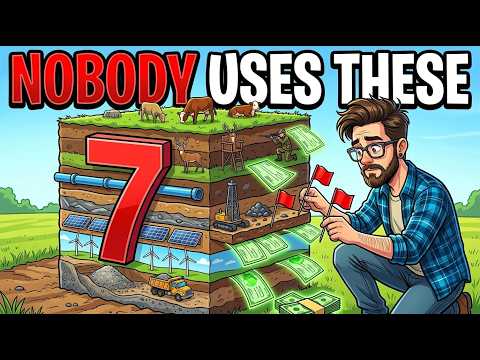
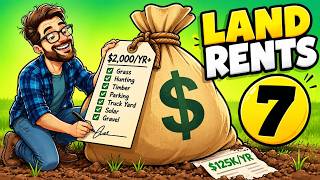
- Seven distinct land-leasing plays exist, ranked from easiest to highest ceiling: grazing, hunting access, timber, event parking, truck/trailer parking, solar, and gravel/sand royalties.
- Grazing leases average $15.50 per acre for pasture (USDA), while cropland cash rent has hit a record $161 per acre in some regions.
- Hunting access leases run $8 to $50+ per acre nationally, with premium river-bottom ground clearing $75 per acre.
- Truck and trailer parking can generate $3,000 to $6,000 per acre per month in inland markets, driven by a nationwide shortage of over 40,000 truck parking spaces.
- Solar land leases can produce roughly $2.56 million in gross income over 25 years on a 100-acre Northeast parcel at an $800-per-acre average.
- Gravel and sand royalties, priced per ton rather than per acre, can generate $30,000 to $125,000 a year from a modestly active pit.
Grazing Leases: The Easiest Way to Monetize Pasture
The simplest play is renting out grass. The USDA puts average pasture cash rent at $15.50 per acre per year, while cropland — the louder cousin — hit a record $161 an acre. On forty acres of pasture, that modest pasture rate works out to roughly $600 a year, but the real appeal is the cost: nothing. The rancher brings the herd, fixes the fence, and hauls the water, while his farm liability policy covers the risk. The landowner's only expense is an optional lease review by a local attorney, typically $200 to $600, one time.
Rates vary enormously by county, and that swing is the landowner's leverage. Texas averages $7.70 an acre statewide, but Falls County in the same state runs $21. Oregon sits near $11, while Wisconsin non-irrigated cropland commands $137. Three moves get a lease started: confirm usable acres through the county parcel record, pull the published cash rent average from the state extension service (free), and write a one-page annual lease with auto-renewal and a rent-review clause tied to that published average. That third step is the entire business — a handshake deal freezes at the original number, while a written review clause drags the rent up with the market on its own.
There is a second payoff: in most states, an active agricultural lease qualifies the parcel for agricultural-use property tax treatment, lowering the carrying cost on land that was previously just being mowed. Timeline runs two to six weeks from first conversation to signed lease, since these are annual deals negotiated before turnout season. Readers exploring other low-cost income setups may find 6 rental business ideas that make money without doing the work a useful next step.
Hunting and Fishing Access: Selling the Season
The second play sells the season, not the land, through hunting and fishing access leases — and the money tends to surprise people. National rates run $8 to $50 per acre per year; in the South, $8 to $25; across the Midwest trophy belt, $25 to $45; in the Northeast, $20 to $50 and up, with premium river-bottom ground clearing $75. A widely cited North Carolina and Virginia analysis put hunter access at roughly $27 an acre — on 100 acres already being walked regularly, that is $2,700 a year for a season otherwise unused.
The access platform LandTrust publishes landowner data showing small farms of 50 to 200 acres running mixed programs (whitetail day access, weekend waterfowl, spring turkey) land in the $3,000 to $10,000 range, while 200- to 800-acre operations run $10,000 to $25,000. Farm Progress profiled Mississippi farmer Bo Prestidge, who built hunting leases across roughly 40,000 acres within a 15-mile radius of his own farm and turned access into a company, Wildlife, Inc. He never bought the acreage; he organized access to it.
Startup cost is effectively zero — the club brings the stands, blinds, and gear. The landowner's real line item is a liability rider, often $150 to $400 a year, only if the club's own policy doesn't already cover it.
The key clause to make non-negotiable: the club carries liability insurance and names the landowner as additional insured, in writing, before anyone sets foot on the property. Leases negotiate in late summer for the autumn season and take four to eight weeks to close. Notably, this lease stacks with grazing — cattle graze in spring and summer, hunters come in autumn and winter, same acres, two tenants, written into one master lease with carve-out language.
Standing Timber: The Crop That Grew Itself
Mature hardwoods on unused acreage represent a five-figure crop that grew without any input. Timber sells per thousand board feet: in Illinois, black walnut averaged $1,760 per thousand board feet, red oak $290. Indiana's consulting forester reports show a weighted average near $1,294 for high-quality sales, while in Pennsylvania, white oak has run $495 to $720. A modest 40-acre hardwood stand, harvested once on a long rotation, is a single five-figure event rather than monthly income.
The entire play starts with one call: contact the state forestry commission for its list of registered consulting foresters. A consulting forester works for the landowner, not the buyer — they cruise the stand, mark the trees, and take sealed competitive bids, typically earning 8 to 10% of the sale price, so their incentive aligns with the seller's. States including New York, Illinois, Pennsylvania, Wisconsin, and South Carolina publish stumpage price reports that let any owner check an offer against real market data. Realistic timeline is two to six months from first call to payment.
Event Parking and Truck Yards: Renting the Gravel
Parking cars on grass works on less than an acre. Event parking near a stadium, fairground, or festival runs $15 to $25 a car for regular-season games and $50 to $100-plus for concerts and playoffs. Landowner platforms advertise $5,000 to $50,000 per event for premium hosting, averaging around $12,500 per event, with per-space benchmarks of $750 to $1,125 per space per year across roughly fifteen major events. Lincoln Financial Field runs about 22 major event days a year; Lumen Field closer to 30 — the goal is capturing a dozen good events near the property, not hundreds. Startup is a mowed field, cones, and signage, plus an event liability policy around $500 to $1,500, often carried by the parking operator instead of the landowner. It is the fastest payday on this list, with money arriving in days to weeks.
A bigger-ticket version of renting gravel is semi-truck and trailer parking. Trailer stalls rent for $75 to $200 a month in most markets; fenced and lit lots pull $100 to $300; secured, port-adjacent yards run $200 to $500; tractor spaces go higher still, $150 to $600 a month or $20 to $60 a night. Roughly 30 to 40 trailer stalls fit on one acre — thirty stalls at $150 a month is $4,500 monthly from a single acre of gravel, and inland yards commonly benchmark at $3,000 to $6,000 per acre per month. Demand is real: the industry estimates the country is short more than 40,000 truck parking spaces, and drivers are legally required to stop with nowhere to do it. Margins run 40 to 55% once gravel base, fencing, lighting, and cameras are factored in, but a bare gravel lot with basic lighting still commands the low end of every range. Zoning is the filter that protects the investment — commercial or industrial zoning, or a conditional use permit, keeps a competing field across the road from undercutting the business.
Solar Leases and Underground Royalties: The Highest Ceilings
Solar land leases are the long game. Rates commonly run $500 to $2,000 per acre per year; Sun Belt states sit at $1,200 to $2,000; substation-adjacent sites push past $2,500; exceptional grid-access parcels have reached $3,000 and beyond. On a 100-acre Northeast lease at an $800 average, published landowner guides put 25-year gross income around $2,560,000 — on ground that grew nothing. The developer covers surveys, interconnection studies, and construction; the only owner expense is an independent attorney review, roughly $1,000 to $3,000. The structure runs as an option (two to five years, small fee, while permits and interconnection are pursued) followed by a lease of 20 to 40 years once the project switches on. The clause that matters most is the escalator — 1.5% to 2.5% a year — which keeps the lease growing in real terms instead of shrinking under a flat rate. Distance to a substation or transmission line is the single biggest driver of developer interest.
The highest ceiling of all seven plays is selling what's under the grass: sand, gravel, and topsoil royalties, priced per ton rather than per acre. The Montrose County, Colorado lease referenced earlier pays $2,000 a year flat plus $1.61 per ton of crushed gravel and $1.93 per cubic yard of pit-run material. A Michigan court record, D'Anna v. Furgal, documents 25 cents per cubic yard paid quarterly against reported removal. A modestly active pit moving 20,000 to 50,000 tons a year at $1.50 to $2.50 a ton generates $30,000 to $125,000 annually from dirt that was already there, with the operator posting the reclamation bond in most states. Two contract details protect the landowner: pricing by verified weight ticket rather than estimated truckload counts, and indexing the royalty to the published producer price index for construction sand and gravel, the same standard Michigan uses in its own state leases. Timeline is the longest of the seven, six months to a year before tonnage flows, though signing and flat-fee payments can land immediately. The extraction permit and reclamation bond required for this business are hard to obtain — which makes them a genuine competitive moat.
Avoiding the Handshake Mistake
The costliest error among landowners pursuing these strategies isn't picking the wrong lease type — it's skipping the paperwork. One landowner agreed to a grazing deal on a handshake with no written term and no review date. Cattle grazed for three straight seasons at $10 an acre, the number agreed to years earlier, while the published county average climbed past $15.50. He was underpaid by roughly a third, and none of it was recoverable. The fix took one afternoon: rewriting the deal as a one-year lease, auto-renewing, with rent tied to the published extension average and a review at every renewal date. The rule that came out of it is simple — no lease should outlive its own renewal date.
Three filters help decide where to start: what the ground actually has (acreage, road frontage, tree cover, distance to a substation, exposed gravel in ditch cuts); whether the use stacks or is exclusive (grazing and hunting stack across seasons; solar and gravel take the whole footprint); and whether the contract includes a renewal date and an escalator. Without those, the lease isn't finished. For a broader view of low-cost passive income ideas, see 6 boring cash-flow machines to buy with $30,000.
Watch the Full Breakdown
For a visual walkthrough of all seven leasing strategies, including the real-world lease documents, county rate tables, and the exact clauses that protect landowners from underpayment, watch the full video on the Harry's Stash YouTube channel. It walks through each play in the order it was presented here, from the simplest grazing lease to the highest-ceiling gravel royalty deal.
Frequently Asked Questions
How much can you make leasing land for grazing?
USDA data puts average pasture cash rent at $15.50 per acre per year, though rates vary widely by county — some cropland cash rent has hit $161 per acre. On 40 acres of pasture, a typical lease generates roughly $600 a year with essentially zero cost to the landowner.
How much do hunting leases pay per acre?
National hunting lease rates run $8 to $50 per acre per year, depending on region. The Midwest trophy belt commands $25 to $45 per acre, while premium river-bottom ground can clear $75 per acre.
Is leasing land for solar profitable?
Yes — solar leases commonly run $500 to $2,000 per acre per year, with Sun Belt states at $1,200 to $2,000. On a 100-acre Northeast lease at an $800 average, 25-year gross income can reach roughly $2.56 million, with the developer covering all construction and interconnection costs.
What is a gravel or sand royalty lease?
It's an arrangement where a landowner is paid per ton or per cubic yard of material extracted, rather than a flat per-acre rate. A modestly active pit moving 20,000 to 50,000 tons a year at $1.50 to $2.50 a ton can generate $30,000 to $125,000 annually.
Can you have multiple leases on the same land at once?
Yes, in many cases. Grazing and hunting leases stack well because they occur in different seasons — cattle graze in spring and summer, hunters use the land in autumn and winter — and can be combined into one master lease with carve-out language. Solar and gravel leases, by contrast, are exclusive-use and take the entire footprint.