- Key Takeaways
- What Asset Location Actually Means
- The Zero Percent Bracket Most Retirees Never Use
- Four Things a Taxable Account Does Well
- Four Fund Types That Don't Belong in a Taxable Account
- The Social Security Trap
- Fixing a Misplaced Portfolio Without Triggering a Bill
- When to Leave Everything Alone
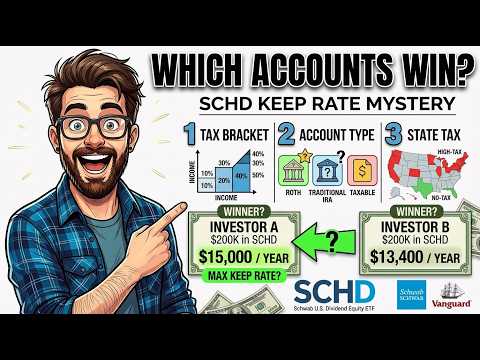
Two retired couples, both 66, both collecting $60,000 a year from their investments. Same income, same year, same country. The first couple pays nothing at all in federal income tax. The second writes a cheque for roughly $2,450. Neither took more risk. Neither picked a worse fund. The entire gap comes down to one overlooked decision: what kind of income their funds produce, and which account those funds happen to sit in. That decision is called asset location, and unlike almost every other retirement lever, it costs nothing to pull.
Key Takeaways
- Two retirees with identical $60,000 incomes can see a $0 versus roughly $2,450 federal tax bill purely from asset location — not risk, and not fund quality.
- Qualified dividends from funds like SCHD, VIG, VOO, and DGRO (often 90%+ qualified) can be taxed at 0% up to $98,900 of taxable income for joint filers in 2026; ordinary-income funds never get that rate.
- Covered call and derivative-income funds such as JEPI, and REIT-heavy funds, generate ordinary income that belongs in a tax-deferred account, not a taxable brokerage account.
- The foreign tax credit (worth up to $300 single/$600 joint) and the state tax exemption on Treasury interest exist only in taxable accounts — an IRA forfeits both.
- Qualified dividends count in full toward Social Security's provisional income test, so income taxed at 0% can still push up to 85% of benefits into the taxable zone.
- Three of the four steps to fix a misplaced portfolio involve no selling at all, so the correction itself triggers no tax bill.
What Asset Location Actually Means
Asset location is different from asset allocation. Allocation is about which funds you own. Location is about which account holds them — a taxable brokerage account, a traditional IRA or 401(k), or a Roth. The same fund, held in two different account types, can produce two very different tax outcomes, even though the investment itself never changes. Because nothing on a brokerage statement flags a location error, most retirees never discover the mismatch. The bill simply shows up later, on a tax return most people hand to someone else to prepare.
The Zero Percent Bracket Most Retirees Never Use
A married couple filing jointly, both 65 or older, has a federal standard deduction of $32,200 in 2026, plus an age-related addition of $1,650 each — $3,300 combined. That creates a shield of $35,500 before any tax is calculated. On top of that, qualified dividends and long-term capital gains have their own 0% bracket, which runs up to $98,900 of taxable income for joint filers in 2026. Stack the two together and a couple living on qualified dividend income can receive roughly $134,400 a year and owe nothing in federal income tax. A temporary additional deduction for people 65 and over, worth up to $6,000 per person and running through 2028, can push that ceiling even higher for qualifying couples.
The catch is that this 0% rate applies only to qualified dividends. Ordinary income — including much of what covered call funds, REITs, and high-turnover funds distribute — never gets it, no matter how large the shield is.
Four Things a Taxable Account Does Well
Qualified Dividend Rates
A dividend is qualified only if the payer is a U.S. corporation or a qualifying foreign one, and the shares were held for more than 60 days inside a 121-day window around the ex-dividend date. Broad U.S. dividend index funds pass this comfortably. SCHD's own tax reporting shows roughly 95% of its distributions qualifying for the lower rate, and VIG, VOO, and DGRO follow the same pattern. As a rule of thumb, broad U.S. dividend and blend index funds typically land above 90% qualified — which is exactly why the question of whether to hold SCHD in a Roth or taxable account matters so much for retirees chasing the 0% bracket.
The Treasury Interest Exemption
Interest from Treasury bills and short Treasury funds like SGOV is fully taxable federally as ordinary income, but it is exempt from state and local income tax because it comes from direct U.S. government obligations. That exemption only survives in a taxable account — inside an IRA, withdrawals are generally taxed as ordinary income by the state regardless of the underlying asset, and the Treasury character disappears entirely. On $150,000 in a short Treasury fund yielding about 3.7% (roughly $5,572 of annual interest), holding it in a taxable account rather than an IRA saves about $279 a year in a state with a 5% income tax.
The Foreign Tax Credit
When a U.S. fund holds foreign shares, the foreign government typically withholds 8% to 15% of the gross distribution before the fund ever receives the cash. In a taxable account, that withheld tax can generally be reclaimed automatically, up to $300 for a single filer or $600 for a couple filing jointly. Inside an IRA or Roth, the same tax is still withheld — but it can never be reclaimed. On a $200,000 international dividend position yielding around 3.4%, that is roughly $680 a year either recovered or permanently lost, depending only on which account holds the fund.
Tax-Loss Harvesting and the Step-Up in Basis
A taxable account allows losing positions to be sold, the loss used to offset gains or up to $3,000 of ordinary income a year, and the proceeds reinvested in something similar. None of that exists inside a retirement account. And when the owner of a taxable account dies, the cost basis resets to fair market value, erasing embedded capital gains for heirs — a benefit with no equivalent in a Roth.
Four Fund Types That Don't Belong in a Taxable Account
Covered call and derivative-income funds — the ones producing large monthly distributions — generate much of their income from options premium rather than ordinary company dividends. That income is classified as ordinary and never qualifies for the lower rate, regardless of the covered call etf tax treatment applied by the fund itself. JEPI's distribution runs around 8%, much of it ordinary; DIVO has recently carried a large proportion of return of capital, with figures as high as 60%, 92%, and 44% in different months per the issuer's own filed notices. On $300,000 in a fund distributing around 8% (roughly $24,000 a year), a couple in the 22% bracket could owe close to $5,000 a year in federal tax on that single holding — a bill that disappears entirely if the identical fund sits in a traditional IRA instead.
REIT distributions face a similar problem. They are generally not qualified dividends, though a 20% deduction on qualifying REIT dividends softens the blow. A discounted ordinary rate is still an ordinary rate — which is why reit etf taxable account tax exposure makes tax-deferred accounts the better home for property-heavy funds. High-turnover funds create a third issue: when a fund sells a holding at a profit, it must distribute the realized gain to shareholders, who owe tax on it whether or not they sold anything themselves. Turnover is published on every fund's fact sheet; anything above roughly a third of the portfolio a year deserves a second look before it goes into a taxable account.
The Social Security Trap
Whether Social Security benefits get taxed depends on provisional income. For a married couple filing jointly, once provisional income passes $32,000, up to half of benefits become taxable; past $44,000, up to 85% do. Those thresholds have never been adjusted for inflation since being set in 1984 and 1993.
Qualified dividends count toward provisional income dollar for dollar, even though they can be taxed at 0% once the calculation is complete.
A couple both 66, drawing $40,000 in Social Security and $40,000 in qualified dividends, has provisional income of $60,000 — half of Social Security ($20,000) plus the full dividend amount ($40,000). That crosses the $44,000 threshold, pushing up to 85% of their benefits into the taxable zone, despite the dividends themselves owing nothing. Income generated inside a Roth account does not count toward this calculation at all, which makes Roth placement a lever here as well.
Fixing a Misplaced Portfolio Without Triggering a Bill
Selling inside a taxable account is a taxable event, and a large embedded gain can cost more to unwind than the placement problem was ever costing in tax. The safer order of operations is:
- Step 1: Redirect new contributions — ordinary-income and property-heavy funds into the retirement account, qualified-dividend funds into the taxable account.
- Step 2: Turn off automatic reinvestment on the misplaced holding and redirect that cash to the correctly placed fund.
- Step 3: Use any remaining tax-deferred contribution room to build ordinary-income positions there instead of adding to the taxable account.
- Step 4: Only if a sale becomes necessary, harvest losses elsewhere in the same year, spread the sale across multiple tax years if it's large, and check the result against the 0% bracket ceiling, Social Security thresholds, and the 3.8% net investment income tax threshold ($200,000 single/$250,000 joint in 2026) before executing.
Required minimum distributions begin at 73 for those born 1951–1959, and 75 for anyone born 1960 or later — a reminder that a traditional account eventually converts everything to ordinary income anyway, which makes it the natural home for holdings that were always going to be taxed as ordinary.
When to Leave Everything Alone
There is one clear exception to all of this: a retiree in their eighties holding a taxable account with very large embedded gains, planning to leave that money to heirs. Selling to fix the placement would trigger tax on gains that the step-up in basis was about to erase completely for free. In that specific situation, the right move is to change nothing.
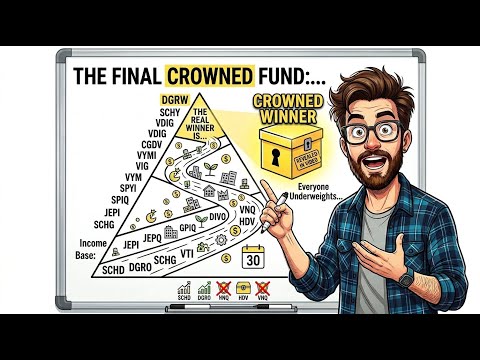
For a full walkthrough of these numbers, including the exact arithmetic behind both retired couples' tax bills, watch the full video breakdown — it covers the same 12 placement rules visually, with the calculations shown step by step. Readers building out a broader dividend strategy may also find the 4-ETF dividend ladder using VIG, DGRO, SCHD, and DIVO useful for thinking through fund selection before placement.
This article is educational information only, not tax or financial advice. Every figure is dated to the 2026 tax year, state rules vary considerably, and individual circumstances can change the right answer entirely. Speak with a qualified tax professional before moving any holdings.