- Key Takeaways
- The Overlap Problem Nobody Checks
- The Core Four: Where Most Portfolios Should Start (and Stop)
- The Specialists: One Job, Nothing Else
- The Situational Seats That Decide Whether It All Works
- Building the Portfolio: Real Numbers
- Auditing an Existing Portfolio
- Watch the Full Breakdown
- Frequently Asked Questions
Two of the most popular dividend funds in America are marketed as opposites. One is the high-yield fund. The other is the dividend-growth fund. Different strategies, different screens, different marketing — and an enormous number of investors own both, believing that ownership equals diversification. The published overlap between them is about 60% of portfolio weight. Not 60% of the fund names. Sixty percent of the actual dollars. An investor holding both funds is largely holding the same companies twice, with two sets of paperwork and two expense ratios.
This is not another video ranking dividend ETFs against each other. Ranking assumes an investor owns one fund. Almost nobody does. Real portfolios hold five, seven, or eleven ETFs, accumulated over years, each purchased for a reason that made sense at the time. The better question isn't which fund is best — it's what job each fund is actually doing, and whether two of them are doing the same one.
Key Takeaways
- SCHD and VYM overlap by roughly 60% of portfolio weight despite being marketed as opposite strategies (high-yield vs. dividend-growth)
- VOO and VTI — the S&P 500 fund and the total stock market fund — overlap by 88.5%, making them functionally the same holding
- A retirement portfolio needs roughly four or five "jobs" filled, not a dozen individual funds
- SCHD's March 2026 reconstitution cut energy exposure by 3–7 percentage points and added technology and healthcare weight — the fund you bought two years ago isn't the fund you own today
- DIVO's "yield" can legitimately be quoted three different ways: a 4.8% distribution rate, a 1.35% SEC yield, and a trailing 12-month figure above 6%
- A five-fund portfolio built around distinct jobs (anchor, growth engine, international, income, cash floor) produced more annual income than a four-fund portfolio stacked with overlapping dividend funds, using identical starting capital
The Overlap Problem Nobody Checks
The starting point for this entire framework is a simple exercise: pull up a free ETF overlap tool and check the funds already sitting in a brokerage account. Most investors have never done it, and the results are usually uncomfortable.
Take VOO (Vanguard S&P 500) and VTI (Vanguard Total Stock Market). VOO holds 518 companies. VTI holds those same 518 plus roughly 3,200 smaller companies that, combined, represent a small enough share of total market value that the two funds move almost identically. The published overlap between them is 88.5%. Both funds cost 3 basis points and are excellent on their own — but owning both is not diversification. It's one seat filled twice.
The published overlap between VOO and VTI is 88.5%. Between SCHD and VYM, it's roughly 60% of portfolio weight, despite one being sold as a high-yield strategy and the other as a dividend-growth strategy.
The framework below treats a retirement portfolio as a set of twelve possible jobs. Most portfolios only need four or five of them filled. Clutter isn't caused by owning too many funds — it's caused by four funds all doing job number one.
The Core Four: Where Most Portfolios Should Start (and Stop)
Seat One: The Anchor — SCHD
The Schwab US Dividend Equity ETF (SCHD) tracks roughly 100 established U.S. dividend payers, screened on cash-flow-to-debt, return on equity, dividend yield, and five-year dividend growth, with an annual rebalance every March. It yields just over 3%, costs 0.06%, and has grown its dividend at about 9% annually over five years and roughly 10.5% over ten years.
Morningstar's April analyst note described the fund's approach as "sensible, transparent and defensive." But the March 2026 reconstitution is worth understanding in detail: it added 25 companies and removed 22, cutting energy exposure by an estimated 3 to 7 percentage points while raising healthcare and technology weight. Investors who bought SCHD two years ago for energy income are now holding a meaningfully different fund. That isn't a flaw — a rules-based index fund doesn't promise to hold what an investor originally bought. It promises to keep applying the rule, and every March, the rule runs again.
Seat Two: Breadth — VYM
Vanguard High Dividend Yield (VYM) holds roughly 615 companies — the higher-yielding half of the U.S. market, weighted by size. It yields about 2.2% and costs 0.04% after a February fee cut. Its overlap with SCHD runs around 21%, which is lower than most investors assume, making it a defensible width play rather than a true duplicate. The trade-off is dividend growth: about 4% annually over five years, versus SCHD's 9%. For a retiree bridging a five-year gap to Social Security, more yield now and slower growth can be the right call. For someone funding a 30-year retirement, the gap compounds meaningfully.
Seat Three: The Quality Compounder — VIG
Vanguard Dividend Appreciation (VIG) requires ten consecutive years of dividend increases across roughly 340 holdings. Its yield is low, around 1.5%, but its five-year dividend growth rate matches SCHD's at about 9% — from a much smaller starting base. It costs 0.04% and overlaps with SCHD by only about 14%, the lowest pairing in this group. A decade-long raise streak is a record of behavior under pressure that a high yield can't fake.
Seat Four: The Bridge — DGRO
iShares Core Dividend Growth (DGRO) sits between SCHD's yield and VIG's growth. It yields about 1.9%, costs 0.08%, and has grown its dividend around 7% annually over five years (8% over ten). Overlap with SCHD runs near 20%. For a deeper comparison of how DGRO's growth trajectory stacks up against SCHD's, see DGRO vs SCHD: The Dividend Growth Stall Investors Need to See.
Anchor, breadth, quality, and bridge cover what most retirement portfolios ever need. The next four are specialists — each does one job well and becomes a mistake if bought for any other reason.
The Specialists: One Job, Nothing Else
Seat Five: The Monthly Check — DGRW
WisdomTree US Quality Dividend Growth (DGRW) holds around 300 names screened on ROE, ROA, and forward earnings growth, paying monthly rather than quarterly. It yields about 1.2%, costs 0.28% — the most expensive fund in this group — and has posted 10-year dividend growth above 12% annually. Its job is calendar smoothing, not higher income. Its August distribution was 5.5 cents per share, down from 6.5 cents in July, a reminder that monthly funds vary month to month even when the long-term trend is upward.
Seat Six: The Streak — NOBL
The S&P 500 Dividend Aristocrats fund (NOBL) applies one criterion without exception: 25 consecutive years of dividend increases, currently qualifying around 69 equal-weighted companies. It yields about 2% and costs 0.35% — nearly six times SCHD's fee. Equal weighting means the smallest qualifier gets the same allocation as the largest, which is a genuine diversification benefit but also tilts the fund toward older, slower industries.
Seat Seven: The Active Seat — CGDV
Capital Group Dividend Value (CGDV) is the only actively managed fund in this framework, managing close to $39 billion despite launching in February 2022. It costs 0.33%, yields about 1.2%, and has outrun its benchmark since inception — though four and a half years of data proves relatively little. The job here is judgment: a rules-based screen must keep holding a deteriorating stock until the next reconstitution date. An active manager doesn't have to.
Seat Eight: Income Now — DIVO
Amplify Enhanced Dividend Income (DIVO) writes covered calls against a concentrated portfolio of large dividend payers. Its fact sheet reports three separate, legitimate yield figures: a 4.8% distribution rate, a 1.35% 30-day SEC yield, and a trailing 12-month figure above 6%. The distribution is what actually lands in the account; the SEC yield reflects dividends alone. It costs 0.56%, the highest fee here, and gives up upside in strong markets when its written calls get exercised. For a deeper look at pairing DIVO with other income and growth seats, see 3-Bucket Dividend Strategy: DIVO, NOBL & SCHD for Retirement.
The Situational Seats That Decide Whether It All Works
Seat Nine: Outside America — SCHY
Schwab International Dividend Equity (SCHY) applies a similar screen to SCHD across roughly 130 developed and emerging-market holdings outside the U.S. It costs 0.08% and yields about 3.4%. One detail is easy to miss: foreign dividend withholding can generally be reclaimed as a foreign tax credit in a taxable account, but not inside an IRA or Roth, where it's simply lost. On a $75,000 position yielding 3.4%, that's roughly a couple hundred dollars a year recovered — or never seen — depending purely on account placement.
Seat Ten: The Growth Engine — VOO
Vanguard S&P 500 (VOO) holds 518 companies, costs 0.03%, and yields about 1% — a job that has nothing to do with income. Every dividend screen in the first nine seats systematically excludes companies that pay little or nothing, and several of those companies have driven a disproportionate share of total market returns in recent years. A portfolio built entirely from dividend screens doesn't just miss that growth by accident — it's designed to.
Seat Eleven: The Twin — VTI
Vanguard Total Stock Market (VTI) holds roughly 3,700 companies, costs 0.03%, and yields about 1%. Its overlap with VOO is 88.5% — in nearly every way that matters for a retirement plan, these are the same fund. Both are excellent; owning both is one seat, not two.
Seat Twelve: The Floor — SGOV
iShares 0-3 Month Treasury Bond ETF (SGOV) isn't a dividend fund. It costs 0.09% and currently distributes around 3.7% — momentarily higher than SCHD's yield. Its job isn't income; it's behavioral insurance. A retiree spending $100,000 a year who holds two years of spending ($200,000) in SGOV generates about $7,430 annually versus roughly $6,050 if the same money sat in SCHD, while never having to sell equities during a downturn. If the market falls 25%, that cash floor means no shares are permanently converted into groceries at the bottom. Treasury bill interest is also generally exempt from state income tax, and the seat should be sized to spending needs, not portfolio percentage.
Building the Portfolio: Real Numbers
Consider $250,000 split evenly across four U.S. dividend funds that substantially overlap — anchor, breadth, quality, and monthly. At current yields, that produces about $4,966 a year. Split the same $250,000 across four genuinely different jobs — anchor, growth engine, international, and floor — and the result is about $6,956 a year, nearly $2,000 more in income from identical capital, because the international and floor seats currently out-yield the quality and monthly funds.
A full five-seat build at $500,000 — 30% anchor, 30% growth engine, 15% international, 15% income now, 10% floor — produces roughly $4,538 from the anchor, $1,560 from the growth engine, $2,513 from international, $3,630 from the income seat, and $1,858 from the floor. Total: approximately $14,100 a year, a blended yield of about 2.8% on the full portfolio, with a growth engine still compounding underneath it and two years of spending protected from a downturn. This kind of layered construction is the same logic behind The Dividend Bridge: Retire 10 Years Before Social Security.
Auditing an Existing Portfolio
Dividend strategies have pulled in more than 60% of all factor fund inflows this year — roughly $54 billion so far, annualizing to about $82 billion, ahead of the previous record of $72 billion set in 2022. A large share of that money is buying a fourth copy of a job an investor already owns.
The fix takes about ten minutes. List every fund held and write one sentence describing what job it does now — not why it was originally bought. If two funds get the same sentence, one of them is a duplicate. If a fund gets no sentence at all, it's worth questioning entirely. Most investors doing this exercise honestly discover they own four or five copies of the anchor, no cash floor, and no growth engine.
Watch the Full Breakdown
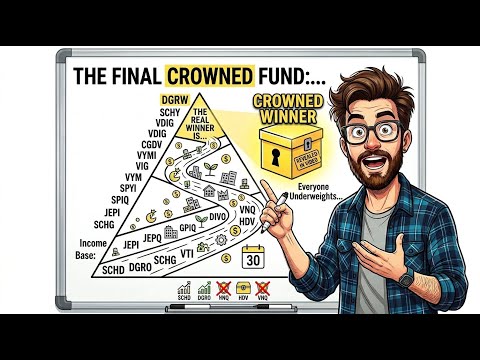
This article covers the mechanics, but the video walkthrough works through the overlap percentages, the SCHD reconstitution data, and both portfolio examples line by line, including the full math behind the $250,000 and $500,000 builds. Watch the full video for the visual breakdown of all twelve seats.
Frequently Asked Questions
How many dividend ETFs should I actually own?
Most retirement portfolios only need four or five funds filling distinct jobs — an anchor, a growth engine, a cash floor, a dividend-growth seat, and optionally one situational fund like an international or high-income ETF. Owning more than that usually means duplicating a job rather than adding diversification.
Do SCHD and VYM overlap too much to own together?
Their published overlap is around 60% of portfolio weight, which is high enough that owning both should be a deliberate choice for extra breadth rather than an assumption of added diversification. Checking an overlap tool before buying a second high-yield fund is the simplest way to confirm.
Is VOO or VTI better for a dividend-focused portfolio?
The two overlap by 88.5%, making them functionally interchangeable for retirement planning purposes. Choosing one instead of both frees up a portfolio seat for something that fills a different job, such as international exposure or a cash floor.
Why does DIVO show different yield numbers in different places?
DIVO's fact sheet reports a 4.8% distribution rate, a 1.35% SEC yield, and a trailing 12-month figure above 6%. All three are correct — they measure different things. The distribution rate includes option premium income; the SEC yield reflects dividends alone.
How much cash should a retiree hold in a fund like SGOV?
The sizing should be based on annual spending, not portfolio size — commonly one to two years of expenses. That buffer lets a retiree avoid selling equities at a loss during a market downturn while dividend income and growth continue compounding elsewhere in the portfolio.