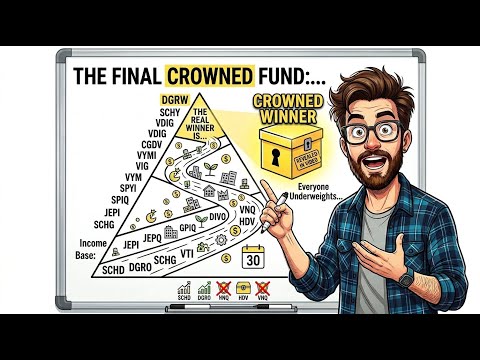
One popular income fund cut its distribution almost in half between spring and summer — from roughly 48 cents per share in April to about 24 cents by July — while its trailing yield still displayed close to 12% on every major data screen. On that same fund page, three completely different yield figures appeared simultaneously: approximately 9.5%, 7.5%, and nearly 12%. The gap between the yield a fund advertises and the cash it actually keeps depositing is the single most expensive misunderstanding in dividend investing.
These 12 dividend ETFs are not sorted by who pays the most today. They are ranked by one test: when the market fell in 2020, and again through the prolonged bear market of 2022, did each fund's payout hold steady and grow — or did it quietly shrink? The funds that passed are the resilient dividend ETFs built to keep raising when rates fall.
Key Takeaways
- A high yield printed on a screen is not the same as a resilient, growing income stream.
- SCHD, VIG, and DGRO kept raising their fund-level payouts through both the 2020 crash and the 2022 bear market, even as prices fell hard.
- A $250,000 blend of dividend growers starting at a combined yield of roughly 1.9% could generate approximately $10,100 in annual income after 10 years at 8% average dividend growth.
- DGRW pays every single month and yields under 1% — proof that monthly distribution frequency says nothing about yield safety.
- NOBL requires 25 consecutive years of unbroken dividend increases just to qualify, filtering out every company that cut during 2008, 2020, or 2022.
- The five-fund resilient core carries a blended expense ratio of roughly 0.16%, compared to the 1% fee a typical financial advisor charges on the same assets.
Nothing in this article is financial advice or a recommendation to buy any specific fund. Every figure is a snapshot that will drift after publication, and the past behavior of any dividend is never a guarantee of future results.
Why the Yield on Screen Is the Wrong Number
When short-term interest rates fall, the income generated by cash accounts, certificates of deposit, and funds that lend at floating rates falls right along with them. A competitive online savings account might pay around 3.4% today, while a large bank pays nearly nothing — roughly 0.01% — on the same balance. As of July 29, 2026, the Federal Reserve held its target range at 3.50% to 3.75%. If and when that range moves lower, income tied to short-term rates will follow.
A dividend growth fund operates by a completely different mechanism. It pays from the profits of real businesses that choose to raise their payout because the underlying business is healthy. Falling rates do not force that kind of company to cut its dividend. If anything, cheaper borrowing can help the very businesses these funds hold. The same environment that quietly drains a floating-rate income fund can leave a dividend grower completely untouched — or even slightly better off.
The Outer Bench: Four Useful Satellites
These four funds each serve a genuine purpose, but they belong at the edges of a portfolio — not at the center. Each one teaches a lesson that makes the resilient core easier to understand and trust.
12. VOO — The Broad Earnings Reservoir
VOO yields only around 1% and hands out far less cash than anything else on this list. Its job is not to deliver income today. At an expense ratio of just 0.03% — three dollars per year on $10,000 invested — it owns the broad earnings power of 500 large American companies, the profits that fund tomorrow's dividends across the entire market. For an investor who does not yet need income, VOO is the low-cost growth reservoir that gradually converts into income as those underlying companies raise their payouts over time.
11. HDV — The High Yield Trap
HDV pays a genuinely attractive yield of around 3%, drawn from a concentrated basket of large, cash-rich American companies. The problem is the growth rate: over the past five years, HDV grew its dividend at under 2% per year — slower than the cost of living rose across the same stretch. An investor relying on HDV for growing income has quietly been losing real purchasing power, even while that comforting 3% yield sat unchanged on the screen. HDV is not a bad fund. But it is the cleanest single proof on this list that a higher yield is simply not the same thing as a resilient one.
10. SCHY — Promising but Unproven
SCHY gathers dividend-paying companies outside the United States at a low cost of 0.08% and pays a yield above 3%. The temptation is real. The critical caveat: SCHY launched in 2021 and has never been tested through a full market cycle. It did not exist during the 2020 crash. Currency swings and foreign tax complexity stack on top of ordinary market risk. International income diversification is genuinely useful — but SCHY should be sized like the young, unproven satellite it honestly is, never like a core a whole retirement depends on.
9. VYMI — International Diversification, Not Precision
VYMI holds approximately 1,600 dividend-paying companies across developed and emerging markets. Its distribution rate sits in the neighborhood of 5%, though foreign payouts arrive irregularly and different data sources genuinely disagree on the precise figure. What VYMI brings is diversification — it keeps income from depending on a small cluster of American names all raising or cutting together. Treat it as seasoning on the portfolio, never the main course, and never a fund whose exact yield can be penciled in with confidence.
The Quality Engines: Four Mid-Tier Picks
These four funds do not always pay the largest dividend, but each is built on the trait that makes a payout sturdy over the long run: durable business quality and rising earnings underneath the distribution.
8. SPHQ — The Quality Screen
SPHQ screens the 500 largest American companies for quality metrics — strong return on equity, stable year-over-year earnings, and low debt on the balance sheet — rather than hunting for the highest yield. Its yield is modest at roughly 1% with an expense ratio of 0.15%. The businesses most able to keep raising a dividend through a real downturn are precisely those with clean balance sheets and steady profits. A business drowning in debt cuts its dividend first when money gets tight. SPHQ is selling the financial strength that lets income survive tomorrow, not the biggest payout today.
7. CGDV — Active Management, Limited Track Record
CGDV is actively managed, with human portfolio managers selecting dividend-paying value companies by hand. It pays just over 1% at a cost of 0.33% and has attracted assets quickly for a young fund. The honest assessment: CGDV launched in 2022, stepping straight into a falling market, which gives it an interesting early record but nothing close to a full market cycle behind it. The active judgment-based lens adds a perspective that no index fund around it can replicate — but a strong start over a few years is not the same as durability proven across decades and real crashes.
6. RDVY — Rising Dividends at a Premium
RDVY screens not just for companies that pay a dividend, but for companies positioned to grow that dividend — combining rising payouts with real earnings and solid profitability. Its results have historically tilted toward financial and industrial names with room to push distributions higher. The catch is cost: RDVY charges 0.47% annually, nearly eight times the expense ratio of the top-ranked fund on this list. On $10,000 invested, that is dozens of dollars leaking out every year, forever. It is a strong idea priced at a meaningful, compounding premium.
5. DGRW — Monthly Payments, No Yield Gimmick
DGRW pays every single month and yields under 1%. Monthly distribution schedules are typically a warning sign — the format most associated with fragile, high-distribution funds that slash their checks the moment conditions turn, exactly like the fund that cut from 48 cents to 24 cents. DGRW is the mirror image of that pattern. It is a quality and dividend growth strategy that simply distributes its modest income on a monthly rhythm. The calendar a fund pays on tells an investor nothing about whether that payment will still be arriving — and growing — ten years from now.
The Resilient Core: Four Funds Built to Raise in the Storm
These are the funds whose income did the one thing that matters most: it kept rising while the price on screen was falling. For a direct head-to-head comparison of two of them, see DGRO vs SCHD: The Dividend Growth Stall Investors Need to See.
4. DGRO — Broad, Cheap, and Diversified Growth
DGRO holds nearly 400 American companies, yields close to 2%, and costs just 0.08% per year. Its selection process favors companies with sustainable payout ratios and genuine room to keep raising — rather than whatever offers the fattest yield today. Based on its distribution history, DGRO's fund-level income held up through the 2020 shock and kept climbing through the 2022 bear market, even as prices dropped hard. For the dividend growth idea delivered broad, cheap, and without single-company drama, DGRO delivers cleanly.
3. NOBL — Twenty-Five Consecutive Years or You Are Out
NOBL holds the Dividend Aristocrats, defined by one strict rule: every company must have raised its dividend for at least 25 consecutive years to qualify. That bar filters out every company that cut during the 2008 financial crisis, the 2020 economic shutdown, or the 2022 bear market. The rule governs the companies inside the fund — it is not a contractual guarantee that the fund's own distribution rises in every single calendar year — but as living proof that resilient dividend growth is a real and screenable characteristic, NOBL stands nearly alone. No marketing slogan can fake a 25-year streak. Its expense ratio is 0.35%.
2. VIG — Boring by Design, Powerful by Result
VIG owns a broad group of American companies with a demonstrated record of raising their dividends, at an expense ratio of just 0.04% — about as close to free as index investing gets. Its yield is roughly 1.5%, which disappoints investors hunting for a large payout. But based on its distribution history, VIG's fund-level income rose through the 2020 shock and rose again through the 2022 bear market — the exact two moments when fragile high-income strategies were sending out cut notices. VIG only holds companies with a proven habit of increasing dividends, so the entire portfolio tilts, by rule, toward businesses that treat a rising payout as a commitment they intend to keep.
An investor who allocated meaningful savings to VIG a decade ago started with a smaller check than a high-yield fund would have handed them. But their income climbed, quietly and steadily, year after year, through every wild thing a market can do — and they never once received a letter announcing their income had been cut in half.
1. SCHD — The One Fund Worth Keeping
SCHD delivers the full dividend growth thesis in one low-cost package. Its expense ratio is just 0.06% — six dollars per year on $10,000 invested, nearly eight times cheaper than RDVY. It pays a yield that actually competes with a savings account, currently around 3%, which is rare for a fund built on growth rather than yield size. Its payout has historically grown at roughly 9–10% annually over the past decade, though no future result is guaranteed. In 2022, when the market fell hard and investors were selling everything that moved, SCHD did not cut its income. It raised it.
To make that concrete with a strictly illustrative example: $250,000 spread across the resilient core — SCHD, VIG, DGRO, DGRW, and NOBL — starts at a combined yield of roughly 1.9%, generating approximately $4,675 in income in year one. If that income grows at 8% annually, broadly in line with what strong dividend growers have delivered historically, it could reach roughly $10,100 per year after a decade without adding a single new dollar to the account. Set that beside a $250,000 high-yield product paying 8% — $20,000 in year one — that then cuts its distribution in half to $10,000. The grower never needed to win on day one. It only needed to keep rising while the high-yielder broke. For a practical look at how this kind of income ladder is built step by step, see 4-ETF Dividend Ladder: How VIG, DGRO, SCHD & DIVO Pay $613/Month.
How to Combine All 12
These funds are not all meant to be held simultaneously. The core — SCHD, VIG, DGRO, and NOBL — does the heavy lifting of a rising retirement paycheck. A growth reservoir like VOO can be added for investors who do not yet need income, and DGRW works for those who prefer monthly deposits, as long as they understand they are buying quality rather than yield. The satellites — SCHY, VYMI, SPHQ, CGDV, RDVY, and HDV — belong only at the edges of a plan, in smaller allocations where their individual weaknesses cannot undermine the whole. Most investors would be well served by two or three funds from the resilient core and perhaps one satellite that fits their specific situation.
The five-fund core carries a blended expense ratio of approximately 0.16%, which comes to about $405 per year on $250,000. A typical financial advisor charging 1% on the same assets would cost $2,500 annually. Over 20 years, that difference alone — ignoring investment growth entirely — approaches $42,000 left in the investor's account rather than paid in fees. Resilient income does not have to mean expensive. It usually means the opposite.
Watch the Full Video Breakdown
For a visual walkthrough of all 12 funds — including payout history charts, the side-by-side rate-cut comparison, and the $250,000 income illustration plotted over time — watch the full video on YouTube. Seeing the income trajectories rise alongside falling price charts makes the resilient signature unmistakable in a way that numbers in a table cannot fully convey. The video also covers exactly how much weight to place on each satellite — and why the fund with the prettiest recent record carries the least track record of all.