- Key Takeaways
- The Numbers Beneath the Headline
- Two Baskets, One Economy
- The Rate Mechanism — Why This Pattern Repeats
- The 2022 Precedent: How SCHD Handles Rate Shocks
- The Honest Counter-Tension: Cash Still Out-Yields SCHD Today
- DGRW, VIG, and the Broader Dividend Growth Theme
- The Takeaway That Outlasts the Headline
- Watch the Full Breakdown
For once, the fund everyone calls boring is winning. Through the end of July 2026, SCHD — the Schwab U.S. Dividend Equity ETF — posted a total return of roughly 24 percent year to date, compared to approximately 9.5 percent for the S&P 500. That is a lead of about 14 percentage points, and it did not arrive by accident. The mechanism behind it is one that repeats every time interest rates and valuations move in a particular direction — and understanding it matters far more than the headline number itself.
Key Takeaways
- SCHD's estimated total return was approximately 24% year to date through July 2026, versus roughly 9.5% for the S&P 500 — a gap of about 14 percentage points.
- Roughly 90% of SCHD's gain came from share price appreciation (~21.8%), not yield — its underlying holdings moved meaningfully higher, not just paid out.
- The primary driver is interest rates: the Fed held at 3.5%–3.75% in late July, with the market pricing in two additional hikes, compressing valuations on long-duration growth stocks and rotating capital toward current cash generators.
- This is a repeatable pattern, not a one-time fluke — SCHD fell only about 3% in 2022 while the broad market dropped roughly 18%, for the same structural reason.
- Cash currently out-yields SCHD (~4% vs. ~3%), but that yield is static and rate-dependent; SCHD's payout has grown at roughly 9% annually over the past five years.
- SCHD's 0.06% expense ratio and dividend-growth mandate make it a long-term income instrument, not a tactical momentum trade.
The Numbers Beneath the Headline
SCHD's price return alone was approximately 21.8% through the end of July. Distributions added roughly another 1.5 percentage points on top of that. This was not a case of a fund limping along while dividend yield rescued the total return figure — the underlying stocks actually appreciated, and that appreciation accounted for roughly nine-tenths of the total gain. The market was rewarding what SCHD owns, not merely what it pays.
To put a concrete number on the gap: consider two investors who each put $100,000 to work at the start of the year. The SCHD investor ends July with approximately $123,000 to $124,000. The S&P 500 index investor holds roughly $109,000. That difference of approximately $14,000 arrived in seven months, from owning the less glamorous fund. This is a backward-looking illustration that ignores taxes and transaction costs, and it is not a forecast. But it captures the scale of what happened — this was not a rounding error.
Two Baskets, One Economy
SCHD tracks a dividend quality screen of approximately 100 companies. Heading into 2026, its heaviest tilts were toward consumer staples, energy, and health care — businesses that generate real cash this quarter rather than businesses projecting large profits a decade from now. The S&P 500, being capitalization-weighted, is far more concentrated in a small group of very large growth names. Same country, same economy — two fundamentally different baskets.
One common misconception is worth correcting: SCHD is not a technology-free index of legacy companies. Two of its largest holdings this year were chipmakers. The difference is concentration, not category exclusion. The S&P 500's return lives and dies with a handful of giant, expensive growth names. SCHD spreads its weight across sectors with visible, near-term earnings. When those giant growth names are priced for perfection and climbing, the index pulls ahead and SCHD looks slow. When those same names get repriced by rate pressure, the index absorbs the impact far more heavily.
The Rate Mechanism — Why This Pattern Repeats
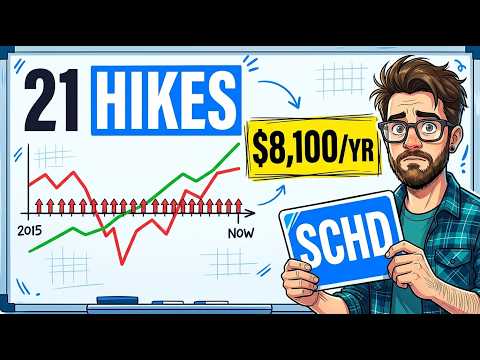
On July 29, the Federal Reserve held its benchmark rate at 3.5% to 3.75%. The market was simultaneously pricing in two additional quarter-point increases before year-end. That is the setup behind SCHD's 2026 outperformance, and the logic is direct.
A stock's intrinsic value is the sum of all future cash flows it will generate, discounted back to present-day dollars. When rates rise — or when the market expects them to rise — that discount rate increases. The further out in time a company's promised cash flows sit, the harder those flows get hit. Expensive growth names, whose investment case rests on enormous profits many years from now, face the largest valuation compression. Mature businesses paying dividends this quarter, with earnings visible right now and lower starting price multiples, hold up comparatively well. Their value is anchored in the present.
Rate pressure compresses distant cash flows more than near ones. Capital then moves toward funds built around near ones. SCHD is built around near ones.
This is a tendency, not a law. Strong earnings growth can and does overpower rate pressure — there have been years where growth names shrugged off higher rates and ran regardless. Rising rates do not automatically mean dividend funds win. What they create is an environment where the odds shift toward funds with current-cash-generating holdings. 2026 has been that kind of year.
The 2022 Precedent: How SCHD Handles Rate Shocks
The clearest historical parallel is 2022 — the last genuine rate shock. SCHD lost approximately 3% that year. The broad market total return fell roughly 18%. SCHD did not outperform by going up; it outperformed by losing far less while valuations on expensive growth names were compressed. The same mechanism was operating, in a more severe environment.
What 2022 also demonstrated is the behavioral value of a dividend growth strategy. Even as SCHD's share price declined, the fund raised its payout that year. For an investor depending on income, the experience was qualitatively different from holding assets where both price and income fell simultaneously. An account that drops in value while income continues to climb presents a very different psychological challenge from one where both move lower. That difference affects whether an investor holds through a drawdown or sells at the worst possible moment — and it is one of the reasons dividend growth investors historically stay invested through volatile periods.
The Honest Counter-Tension: Cash Still Out-Yields SCHD Today
A complete picture requires acknowledging the real competition. A plain money market fund is currently yielding approximately 4%. SCHD's yield sits around 3%. On a pure current-income basis, cash wins — with no equity risk attached.
The relevant comparison, however, is forward-looking. Cash's 4% yield is a function of short-term interest rates. The day the Fed begins cutting, that yield falls with it. There is no growth engine beneath it. SCHD's approximately 3% yield, by contrast, is attached to three moving parts: the dividend itself, the historical growth of that dividend (approximately 9% annually over the past five years), and the price of the underlying equities — which can rise, but which can also fall. SCHD's 0.06% expense ratio means virtually none of the return is consumed by fees.
Project that dynamic forward over a 15- to 20-year horizon and a fork emerges. Cash delivers a larger check today with a yield that will likely contract once rates move lower. A quality dividend fund delivers a smaller check today attached to businesses whose mandate is to keep raising it. If that historical growth rate even roughly holds — and it is not guaranteed; dividends can be cut and share prices can fall — the smaller check eventually overtakes the flat one. The right answer between cash and SCHD depends almost entirely on time horizon. For capital needed in the next twelve months, cash may well be the correct answer. For income needed across decades, the calculation shifts materially.
If you have previously considered pausing contributions to a dividend ETF to hold cash instead, the real cost of that decision is worth understanding — as examined in Pausing Dividend ETFs for 6 Months: The $13,900 Mistake.
DGRW, VIG, and the Broader Dividend Growth Theme
SCHD is not the only fund built around dividend quality and growth. Funds like DGRW and VIG operate on the same core principle — screening for companies with the profitability and track record to consistently raise their distributions over time. The 2026 rate environment put SCHD in the spotlight, but the broader dividend growth theme is what the underlying conditions have rewarded.
For a closer look at how SCHD's dividend growth trajectory compares to DGRO — another fund frequently paired with SCHD in income portfolios — this comparison of DGRO vs. SCHD covers the growth stall pattern that investors in both funds should understand before choosing between them.
The Takeaway That Outlasts the Headline
SCHD beat the S&P 500 in 2026 by roughly 14 percentage points through July — not because it became a permanently superior fund, but because it walked into a rate-pressured environment carrying exactly the kinds of businesses that environment rewards: current cash generators, lower starting valuations, real dividends paid today. When rate pressure compressed the distant promises, capital rotated toward the near cash, and SCHD is structured around near cash.
Whether SCHD will continue outperforming is genuinely unknown. In a growth-led bull market, the broad index has historically reclaimed its lead. Cash at 4% still out-yields SCHD today. This was a valuation and rotation story, not a permanent character change in the fund.
What does outlast the headline is the mechanism itself. Every time rates and valuations move in this direction, the same rotation tends to play out. Understand the mechanism, and a shift in performance leadership stops being a surprise — and starts being a predictable consequence of how the market prices the time value of money.
Watch the Full Breakdown
For a visual walkthrough of SCHD's 2026 performance versus the S&P 500 — including the exact return figures, how the interest rate discount mechanism works, and the full cash-versus-dividends trade-off — watch the complete breakdown on the Harry's Financial Fitness YouTube channel: SCHD Is Beating the S&P 500 in 2026 — Here's What Changed.
This article is for educational purposes only and does not constitute financial advice. All figures cited are illustrative and historical. Past performance does not guarantee future results. Always conduct your own research before making investment decisions.