- Key Takeaways
- What Happened to Treasury Yields and the Fed
- How Each Side Works: Treasury vs SCHD
- The 10-Year Income Math at Four Dividend Growth Speeds
- What Each Is Worth After 10 Years
- What Happened After July 2007 and October 2023
- Three Investor Profiles and the 50/50 Split
- What to Watch From Here
- Watch the Full Video Walkthrough
For the first time since July 2007, the 10-year Treasury yield closed at 5%. By October 1, 2026, it had reached about 5.25%. On $100,000, a 10-year Treasury bought that week pays about $5,250 a year, fixed, and returns your $100,000 at maturity. The same money in SCHD pays about $3,220 this year. That raises a question many dividend investors are asking: why own SCHD at roughly 3.2% when the government will pay you 5%? This article runs the 10-year math both ways.
Educational only, not financial advice. Rates come from the Federal Reserve's published data and SCHD payouts from its distribution history. The projections are models, not predictions, and past performance does not guarantee future results.
Key Takeaways
- The 10-year Treasury yield closed at 5% on September 15, 2026, the first time since July 2007, and reached about 5.25% by October 1.
- On $100,000, the Treasury pays about $5,250 a year versus about $3,220 from SCHD today.
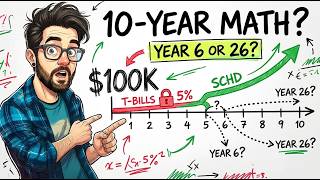
- At SCHD's 10-year dividend growth pace (about 10.5% a year), its yearly check passes the Treasury's in year 6. At its 2026 pace (about 2%), it takes until year 26.
- In every one of SCHD's 59 ten-year periods so far, the share price at least nearly doubled, though those windows came in a strong stretch for stocks.
- After July 2007, the Treasury paid more income every year for a decade, yet VIG and VYM still finished ahead on total value by 2017.
- A 50/50 split is a reasonable middle path for many investors.
What Happened to Treasury Yields and the Fed
On Monday, September 15, the 10-year Treasury yield closed at exactly 5%. According to the Federal Reserve's daily data, the last close at or above 5% was July 19, 2007, nineteen years ago. By the end of September it reached about 5.3%, and on October 1 it closed at about 5.25%.
The day after yields crossed 5%, the Federal Reserve raised its target range by a quarter point, to between 3.75% and 4%. It was a unanimous vote and the first hike since July 2023. The reason is inflation: consumer prices were up about 3.3% in the twelve months to August. According to CNBC's reporting, the 10-year yield had risen about a full percentage point from its February low as higher oil prices pushed inflation back up over the summer.
Nobody rang a bell at 5%. Rates could keep climbing or fall back, and anyone claiming to know is guessing. So the math below does not depend on predicting rates. It compares what you could lock in today against what SCHD has actually done.
The 10-year Treasury matters to dividend investors because it is the yardstick for every income investment. When the government pays 5% with almost no risk, a stock fund paying 3% has to justify itself. Some buyers sell the fund and buy the bond. SCHD closed at about $35.21 on August 24, its high for the year, and at about $32.72 on October 2, roughly 7% lower.
The Gap at Bigger Amounts
- $250,000: Treasury about $13,125 a year, SCHD about $8,050.
- $500,000: Treasury about $26,250, SCHD about $16,100.
- $1,000,000: Treasury about $52,500, SCHD about $32,200.
That is a gap of roughly $20,000 a year on $1 million, which is why the headline matters most to retirees.
How Each Side Works: Treasury vs SCHD
The 10-Year Treasury
You lend the government $100,000 and it pays a fixed rate, about 5.25% if bought that week, so about $5,250 a year, paid twice a year. After ten years you get your $100,000 back. The check never grows or shrinks. The interest is exempt from state and local income tax, though federal tax still applies.
The catch is price risk. If you sell before maturity, the price depends on rates at that moment. If a new 10-year Treasury paying 5.25% is followed by a jump in rates to 6.25%, it would be worth only about $92.65 per $100 paid. If rates fell to 4.25%, it would be worth about $108. A Treasury is only riskless if you hold it to the end.
SCHD, the Schwab U.S. Dividend Equity ETF
SCHD owns about 100 American companies with long records of paying and raising dividends. It costs 0.06% a year and holds about $111 billion. At $32.72 a share, $100,000 buys about 3,056 shares. Over the last twelve months each share paid about $1.05, a yield of about 3.2%, or about $3,220 a year on $100,000.
Unlike the Treasury, that check can grow. Over ten years SCHD's payout grew about 10.5% a year, and about 9% a year over five. In every calendar year since its first full year in 2012, it paid more per share than the year before: about 27 cents in 2012 (split-adjusted) to about $1.05 in 2025, almost four times as much. Even in 2022, when rates rose fastest in decades, SCHD raised its payout about 14%.
The honest caveat: over the last twelve months, SCHD's payout grew only about 2%. The whole question is which SCHD shows up for the next ten years, the one that grew checks 10% a year or the one that grew them 2%.
The 10-Year Income Math at Four Dividend Growth Speeds
Assume $100,000 in each, spending the income with no reinvesting. The Treasury pays $5,250 a year, $52,500 in total, then returns $100,000.
- Speed 1, about 10.5% growth: SCHD's check passes the Treasury in year 6 (about $5,335) and reaches about $7,984 by year 10. Ten-year income is about $52,870, almost exactly the Treasury's $52,500.
- Speed 2, about 9% growth: The check passes the Treasury in year 7 and reaches about $7,084 in year 10. Ten-year income is about $49,300, about $3,200 less than the Treasury. It catches up on total income in year 12.
- Speed 3, 5% growth: The check passes the Treasury in year 12. Year 10 pays about $4,998, and ten-year income is about $40,500, roughly $12,000 less. This is the most realistic case, and it means eleven straight years of smaller checks than the Treasury.
- Speed 4, about 2% growth (the 2026 pace): The check does not pass the Treasury until year 26. Year 10 pays about $3,850 and ten-year income is about $35,300, more than $17,000 less.
On income alone, the Treasury wins three of the four races and ties the fourth.
What Each Is Worth After 10 Years
The Treasury returns exactly $100,000. SCHD's value is unknown, but if its yield stays in a steady range, the share price grows with the payout. Under that assumption, $100,000 would be worth about $274,000 at speed 1, $240,000 at speed 2, $163,000 at speed 3 and $122,000 at speed 4.
History offers a second look. SCHD has 59 ten-year periods, starting every month from late 2011 to late 2016. In every one, the share price at least nearly doubled: the worst gained about 93%, the median about 122% and the best about 208% on price alone. But those windows ended between 2021 and 2026, one of the best stretches for American stocks in history, so the next decade may not be as kind.
The yield assumption also needs care. SCHD's year-end yield has ranged from about 2.5% to about 3.8% since 2012, and today's 3.2% sits mid-range. But the yield drifted up from about 2.8% at the end of 2021 to about 3.8% at the end of 2025, meaning checks grew faster than the share price.
Inflation and Taxes
The Treasury's $5,250 stays $5,250. At 3% annual inflation (an assumption), the tenth check buys about what $3,900 buys today, and the $100,000 returned buys about what $74,000 buys today. SCHD's checks outpace 3% inflation at the first three growth speeds.
For a married couple in the 22% federal bracket (15% on qualified dividends) in a state with a 5% income tax, the Treasury's $5,250 is taxed federally but not by the state, leaving about $4,095. SCHD's roughly $3,222 is taxed at the qualified rate federally plus state tax, leaving about $2,578. Inside an IRA or Roth, the pre-tax numbers tell the whole story. To be fair to the Treasury, the 10-year inflation-protected Treasury yielded about 2.7% above inflation in late September, one of the best guaranteed real returns in years.
If You Reinvest Everything
Reinvesting for ten years, the Treasury investor ends with about $167,900. The SCHD investor ends with about $220,300 at 5% payout growth, about $321,000 at 9%, and about $166,300 at 2%, almost exactly the Treasury. In year 11, the 5%-growth SCHD pile pays about $7,449 a year. The Treasury pile pays about $8,815 if rates are still 5.25%, but only about $3,862 if rates have fallen back to about 2.3%, where they were in 2017. That is the gamble inside the safe choice: you know what the Treasury pays for ten years, not what the money earns after.
What Happened After July 2007 and October 2023
On July 17, 2007, the 10-year yield was about 5.08%. SCHD did not yet exist, so compare VIG (Vanguard Dividend Appreciation) and VYM (Vanguard High Dividend Yield). The Treasury paid $5,080 a year. VYM paid about $2,603 in 2008, about $1,968 in 2010 and about $3,979 in 2016. VIG paid about $1,766 in 2008 and about $3,143 in 2016. The Treasury won on income every year for a decade.
The crisis was brutal for stocks: by early 2009, $100,000 in VYM was worth about $41,400 at its low. Meanwhile the 10-year yield fell to about 2.1% by the end of 2008, lifting the value of a 5.08% note to about $123 per $100.
Yet by July 2017:
- Treasury: $50,800 of interest plus $100,000 back, about $150,800.
- VYM: about $29,900 of dividends plus shares worth about $142,200, about $172,100.
- VIG: about $23,600 of dividends plus shares worth about $160,800, about $184,400.
- S&P 500: about $21,000 of dividends plus shares worth about $158,700, about $179,700.
Finishing ahead required not selling in 2009, and plenty of people did sell. The Treasury investor also had to reinvest at about 2.3% in July 2017, cutting a $5,000 paycheck to about $2,300. Holding VIG from July 2007 to today would have produced about $68,300 in dividends and shares worth about $405,000. A locked rate is locked going in, not coming out.
The second time was October 19, 2023, when the 10-year closed at about 4.98%. A $100,000 SCHD investment that day, with dividends reinvested, is worth about $156,500 today. Spending the dividends instead, you would have collected about $13,100 and the share price is up about 40%. The Treasury buyer has collected roughly $14,700 of interest and still holds a bond that returns $100,000 in 2033, leaving the SCHD buyer about $40,000 ahead. That bond would fetch only about $98.44 per $100 if sold today.
In both cases, rates later fell, and the Treasury won the income race while dividend funds won on total wealth.
Three Investor Profiles and the 50/50 Split
- Age 45, still working, 20-year horizon: This investor needs growth, not income now. In every version of the math, reinvested SCHD matched or beat the Treasury after ten years.
- Age 62, just retired with $500,000: The Treasury pays about $26,250 a year versus about $16,100 from SCHD. A 50/50 split pays about $21,175 and keeps half the money growing.
- Age 75, wanting the biggest predictable check: A ten-year horizon matches the bond well, so locking a chunk at 5.25%, free of state tax, could be exactly right, with SCHD as the foundation for the rest.
For a split of $50,000 in each, year one pays about $4,236. At 5% payout growth, year 5 pays about $4,583 and year 10 about $5,124, almost exactly the full Treasury's check. At 2% growth, year 10 pays about $4,550. Half of your income is fixed even in a bad year for stocks, which often helps people hold the other half.
For money you will need soon, three-month Treasury bills yielded about 4.17% on October 1. $25,000 earns about $1,042 a year, a parking spot rather than a paycheck, since it falls if the Fed cuts.
What to Watch From Here
- SCHD's December payment: Last December it paid about 27.8 cents a share. A clearly higher check suggests the slow lane is ending; a flat or lower one means the 2026 stall continues.
- Inflation: Above 3%, the Fed likely stays tough and the locked Treasury check looks better for longer. If it cools, rates tend to fall, which has historically lifted dividend funds.
- The 10-year yield: If it climbs toward 6%, the case for a split gets stronger. If it falls below 5%, anyone who locked in this month will be glad.
The 5% Treasury is the best guaranteed deal for income investors in nineteen years, but it is a different tool from SCHD, not a replacement. The Treasury protects the next ten years; SCHD aims to build the ten after that. If SCHD's payout growth returns toward its long-term pace, the dividend side wins this race in about seven years. If it stays near 2%, the 5% line wins on income for a generation.
For more on dividend growth trends, see DGRO vs SCHD: The Dividend Growth Stall Investors Need to See and 3-Bucket Dividend Strategy: DIVO, NOBL & SCHD for Retirement.
Watch the Full Video Walkthrough
For the charts and year-by-year numbers, watch the full video on YouTube: Treasuries Just Hit 5% for the First Time Since 2007 - I Ran the 10-Year Math on $100,000 in SCHD. Next in the series: I Put $100K In SCHD - Here's What It Pays. Would you lock in 5%, own SCHD, or split it? Tell us in the comments.
I'm not a financial advisor and this isn't financial advice. Always do your own research. Past performance does not guarantee future results.