Two investors each commit $250,000 to retirement income. The first buys a fund paying 8%, collecting roughly $20,000 in year one. The second buys a basket of lower-yielding dividend ETFs and collects about $5,500 in year one. On paper, the first investor looks like the clear winner. But seventeen years later, the math quietly reverses — and the investor who chose the smaller, rising income ends up with a paycheck the static 8% yield can never match. That single insight captures the spirit of fourteen dividend investing lessons that only become visible after years of watching real funds behave through real crashes, real tax seasons, and real mistakes.
Key Takeaways
- One durable anchor ETF with a rising dividend beats a collection of funds you cannot fully explain.
- SCHD and VYM share 14–29% of weighted holdings — owning both is less diversified than most investors assume.
- A growing 3% yield historically overtakes a static 8% yield at the 17-year crossover — the most counterintuitive truth in dividend investing.
- The DALBAR behavior gap shows investors trailing their own funds by more than 8 percentage points in a single year, purely from poor timing decisions.
- In the 2026 tax year, qualified dividends are taxed at 0% federally for income up to $49,450 (single) or $98,900 (married filing jointly).
- A cash floor prevents forced selling in downturns — the most important structural protection in any retirement income plan.
What You Own: The Foundation of Dividend Investing (Truths 1–5)
One Anchor Fund, Overlap Reality, and Why Boring Wins
Accumulating eight or nine dividend funds without being able to explain why you own half of them is not diversification — it is anxiety dressed as strategy. Truth 1 is that a single durable anchor holding does more useful work than a drawer full of tickers bought one article at a time. Using SCHD as a teaching illustration: a current yield of approximately 3.11%, an expense ratio of 0.06%, and roughly 100 dividend-screened companies. The behavior that matters most is this — SCHD raised its per-share dividend by approximately 14% during the 2022 bear market, even as its share price was falling. The dividend check to shareholders rose at the exact moment the crowd was panicking about the price. That is what durable means in practice, and it is worth more than any shelf of funds assembled out of anxiety.
Truth 2 addresses one of the most quietly damaging assumptions in dividend ETF investing: that owning two dividend funds automatically means being diversified. SCHD and VYM, commonly paired as distinct strategies, share somewhere between 14% and 29% of their weighted holdings depending on the methodology used. That range exists because overlap tools genuinely disagree on their calculations — and the disagreement is itself the lesson. These funds are not redundant, but they are far more similar than their separate marketing suggests. Owning both while believing you are well spread out is a form of invisible concentration that only becomes apparent when you look at the actual holdings rather than the label on the box.
Truth 3 is that the boring fund usually wins. VIG (used as an illustration, yield approximately 1.48%, expense ratio 0.04%) requires any company in its index to have raised its dividend for at least ten consecutive years. The fund makes no headlines. Through both 2020 and 2022 — two separate shock years — its payout did not freeze or cut; it kept rising. Boring is not a weakness in a dividend fund. It is a track record that survived the exact years that scared most investors out of the market.
Truth 4: The 17-Year Crossover That Reframes High Yield vs. Dividend Growth
Split $250,000 evenly across three growing dividend funds — SCHD at approximately 3.11%, VIG at approximately 1.48%, and DGRO at approximately 1.88% — and year-one income lands around $5,500. A generic high-yield product at 8% on the same $250,000 delivers roughly $20,000 in year one. The high-yield fund wins easily at the start, which is precisely why most investors never stay patient long enough to reach the crossover.
If those three growing funds compound their dividends at historically observed rates — and past performance is not a guarantee of future results — that blended income climbs year after year while the static 8% payout sits unchanged. The crossover, where rising income overtakes the large static check, arrives at approximately the 17-year mark.
DGRO illustrates the dynamic well. Its yield of approximately 1.88% is roughly two-thirds of SCHD's, but it is built to buy the raise rather than maximize the current check. For a detailed comparison of how these two ETFs diverge over time, DGRO vs SCHD: The Dividend Growth Stall Investors Need to See walks through the numbers. The broader concept of when growing passive income crosses a meaningful threshold is explored in Dividend Crossover Point: When Passive Income Replaces Your Salary.
Truth 5: The Only Guaranteed Number in Investing Is the Fee
Returns are uncertain. Dividends can be cut. But the expense ratio is contractually deducted regardless of performance — it is the one number the fund industry can promise will be taken from you. Take $250,000 growing at 8% annually for 20 years. In a low-cost portfolio with a blended expense ratio near 0.06% (using SCHD, VIG, and DGRO as illustrations), that compounds to approximately $1.15 million. Wrap the same portfolio in a 1% advisory fee and it compounds to approximately $957,000. The difference — roughly $196,000 — came from nothing but cost drag. No superior decisions created that gap. No better fund picks. Only the fee. VOO charges 0.03% — three cents per year on every $100 invested. Low cost is one of the only structural edges available to every investor regardless of skill level.
How You Behave: Where Most Dividend Income Is Quietly Won or Lost (Truths 6–10)
Reinvest Everything and Reframe What a Market Crash Means
Before retirement, the most powerful single action in dividend investing is reinvesting every payment back into more shares. Truth 6: a reinvested dividend buys additional fund units, those units pay their own dividend next quarter, which buys more units, which pay again. Two investors who buy the same fund on the same day diverge dramatically over 20 years — not because one chose better funds, but because one kept reinvesting and the other redirected small amounts toward spending. Every dollar redirected away from reinvestment interrupted a compounding chain that would otherwise have run for decades. In the accumulation years, reinvest everything and leave it alone.
Truth 7 reframes what a falling market means for an income investor. A durable dividend fund that keeps raising its payout while its price falls delivers a compounding benefit: every reinvested dividend and every new contribution buys more shares at a discount, and each of those discounted shares will pay income for decades. The right question during any downturn is not what the balance did today but what the income did. If income held or grew, the plan is working regardless of the number on the screen. SCHD raised its dividend during 2022 even as its share price declined. The balance reflects market sentiment. The income is the actual result of the strategy.
The Yield Trap, the DALBAR Gap, and Automation as the Practical Solution (Truths 8–10)
Truth 8: a shockingly high yield is most often a warning signal, not a reward. Yield is calculated by dividing a dividend by a price. When a price collapses because the market anticipates a dividend cut, the yield figure spikes — and that spike reads as generosity to investors scanning for income. Dividend growth funds deliberately screen out the highest yielders for exactly this reason. The largest yield on the shelf is frequently the one most likely to be cut.
Truth 9 is the behavior failure that costs the most: overtrading driven by impatience. The DALBAR research effort measures the gap between what funds return and what investors inside those funds actually earn. In one recent year, the average equity investor trailed the market by under a single percentage point. In the prior year, that same type of investor trailed by more than eight full percentage points — driven almost entirely by buying high and selling low at the wrong moments. Morningstar separately estimates the average invested dollar earns approximately 1.2 percentage points less per year than the fund it sits in, purely from poorly timed decisions. The direction of the gap is consistent: activity costs. The most expensive habit an income investor can develop is the urge to do something when the market is loud.
Truth 10 is the practical mechanism that makes behavioral discipline possible: automate the buying so feelings never reach the account. A fixed amount on a fixed schedule purchases shares whether the morning headlines feel terrifying or euphoric. Contributions accumulate at high prices and at low ones, and that consistency quietly outperforms the investor who attempts to time every entry. Willpower is not a reliable long-term strategy. A schedule is.
Income That Lasts: The Retirement Chapter (Truths 11–14)
Growth of Income and the 0% Qualified Dividend Bracket
Truth 11: a fixed income that feels generous on the first day of retirement quietly loses purchasing power over the next fifteen years. Prices continue rising; the static check does not. This is the long-term cost of prioritizing today's yield over tomorrow's growth. DGRW (used as an illustration, yield approximately 1.26%, monthly distribution) has grown its dividend at a historically strong pace over the past decade despite a yield that looks modest at a glance. NOBL (illustration, yield approximately 2%, expense ratio 0.35%) holds only companies that have raised their dividend for at least 25 consecutive years. The modest yield that rises protects purchasing power in year twenty and year twenty-five. The large static yield quietly loses the race against inflation, and the damage accumulates gradually before becoming visible all at once.
Truth 12 is the one that could quietly hand many retirees a raise the market never had to provide. Under 2026 federal tax rules, the rate on qualified dividends and long-term capital gains is 0% for taxable income up to $49,450 for single filers and up to $98,900 for married couples filing jointly. When the standard deduction is layered on top, a retired couple with modest other income can receive a meaningful stream of qualified dividends and owe nothing federally on that portion. These thresholds change in future tax years and individual situations vary widely — a qualified tax professional should review any plan that relies on this bracket. The structural principle, however, is durable: where you hold your funds determines whether the tax code works for you or against you. Two investors can own identical ETFs, receive identical dividends, and face completely different tax outcomes based solely on account placement.
Truth 13: The Cash Floor That Makes Everything Else Survivable
Every truth in this article rests on one assumption: that you never have to sell shares at the bottom of a crash to cover an ordinary expense. The moment that becomes necessary, the strategy breaks. A forced sale in a downturn locks in a permanent loss, eliminates the shares that would have paid income for decades, and converts a temporary market decline into lasting damage to the portfolio.
The fix is structural: maintain a cash reserve outside the market that covers a meaningful portion of planned retirement spending. When a downturn arrives, spend from the floor. Let the dividends keep flowing, let the durable funds continue raising payouts, and wait for the recovery that has historically always come. The cash floor earns almost nothing. That is the point — it exists not to grow but to buy the one thing every other truth in this article depends on: time.
Two investors face the same market crash. One has a cash floor and pays bills from reserves while every share keeps working. The other has no floor, is forced to sell into the decline, and permanently eliminates shares that would have paid income for the next twenty years. Same crash. Same funds. Completely different retirement — determined entirely by the presence or absence of that floor.
The least exciting dollars in a retirement portfolio are often the most important ones. They protect everything else from being liquidated at the worst possible moment. They are not a drag on the plan — they are the insurance policy that allows the plan to survive contact with real market conditions.
Truth 14: The One Principle That Contains All the Others
Buy durable, growing income. Keep it simple. Let time do the rest.
Every truth above points in the same direction: own fewer things you understand deeply, prize income that rises over income that merely looks large today, keep costs microscopic, automate contributions so feelings never touch the account, maintain a cash floor so no crash can force your hand, and use account placement deliberately so the tax code works in your favor. That is the complete list. It fits on one page — not because the subject is shallow, but because after enough time and enough mistakes, the answer turns out to be short.
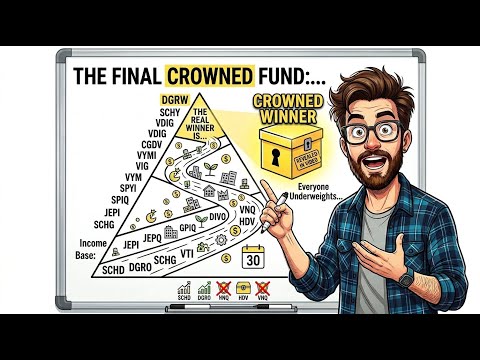
The funds referenced throughout — SCHD, VIG, DGRO, DGRW, NOBL, VYM, and VOO — appear as teaching illustrations because their behavior demonstrates these principles, not as recommendations to buy or sell any security. Specific yields, thresholds, and expense ratios reflect current figures and will change over time. What does not change is the shape of the strategy: durable, growing, low-cost, behaviorally sound, tax-aware, and protected by a cash floor. Build that structure, automate it, and leave it alone. Time is the most patient and most powerful force in any long-term income plan, and these fourteen truths exist to help it do its work undisturbed.
Watch the Full Video Walkthrough
The companion video on the Harry's Financial Fitness YouTube channel covers all fourteen truths in sequence, including the crossover chart comparing rising dividend income against a static 8% yield, the full fee-drag calculation between low-cost and 1% advisory structures, and the cash floor framework in detail. Watch 14 Dividend Truths It Took Me 20 Years to Learn for a complete visual walkthrough of every concept in this article.