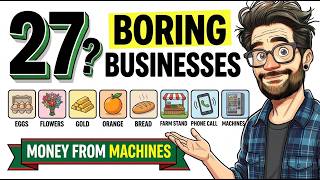
A machine on a quiet roadside hands over a dozen farm eggs. Another sells a bouquet of flowers at eleven at night. Another sells a gold bar. Nobody expects any of them, and that is why businesses like these are still wide open in most ordinary towns. This guide covers 27 boring businesses that almost nobody has started: twenty service and asset businesses, plus seven unattended vending machines that sell things people never expect to find in a machine.
The guide combines two of our deepest deep-dives into one. The first part covers twenty boring businesses, grouped into four capital tiers, and most of them start with little more than a phone call. The second part covers seven unattended machines, from fresh-squeezed orange juice to a warm loaf of bread at six in the morning. Both parts rest on the same idea. Boring, local, repeat-demand work faces less competition than trendy online ideas.
Key Takeaways
- The guide lists 27 boring businesses in two groups: 20 low-glamour businesses across four capital tiers, and 7 unattended machines.
- Most of the 20 businesses can begin with a phone call rather than a large purchase.
- Unattended machines sell everything from farm eggs and late-night bouquets to gold bars, fresh-squeezed orange juice and warm bread at six in the morning.
- These ideas stay open because they look dull, so few people in a normal town have started them.
- Climbing the capital tiers lets you reinvest early earnings instead of borrowing to start big.
- The easiest business on the whole list is also the dullest, and it is probably still unclaimed near you.
Why Boring Businesses Are Still Wide Open
Most people who want to start a business look for something exciting. They search for apps, online courses, dropshipping and content channels. Those fields are crowded because they are glamorous. Meanwhile, ordinary local needs go unmet in nearly every town because nobody wants to talk about them at a party.
A boring business has three traits in its favor. Customers need it whether or not the economy is exciting. The work is simple enough to learn quickly. And few competitors bother to enter, so a modest operator can become the obvious local choice. Our earlier piece, 6 Boring Businesses That Make Money (Under $500 to Start), makes the same case on a smaller scale.
The point is not that these ideas are secret. It is that they sit in plain sight, and the people who could start them keep walking past them.
Part One: 20 Boring Businesses Across Four Capital Tiers
The first half of the video sorts twenty business ideas into four tiers by how much capital they need. The structure matters because it turns the list into a ladder rather than a menu. You start on the lowest rung with almost no money, and each tier gives you a clearer idea of what to add next once the earlier work is paying.
Tier One: Start With a Phone Call
The lowest tier is for people with no savings to spare. Most of these businesses begin with nothing more than a phone call: you contact a potential customer, offer a clear service, and use their equipment or a small starter kit to do the job. They work because the barrier is time and reliability, not money.
Service businesses of this kind include cleaning, hauling, detailing and similar work. If you want a concrete picture of what a first-tier service looks like, see our breakdown of mobile auto detailing and our guide to starting a junk removal business.
Tier Two: Small Purchases, Repeat Customers
The second tier asks for a modest outlay, typically a tool, a vehicle upgrade or a piece of equipment. The reward is repeat business. Customers who need the service every week or every month turn a one-time job into a predictable calendar, which is where a boring business starts to feel like a real one.
Tier Three: Assets That Work While You Sleep
The third tier shifts from selling your labor to owning something that earns. This is where rental-style models and small cash-flowing assets appear. Readers who like this angle can compare it with 6 Rental Business Ideas That Make Money Without Doing the Work.
Tier Four: Larger Capital, Larger Systems
The top tier needs the most capital and usually involves buying into an existing, proven operation. Our guides to cash-flow machines you can buy with $30,000 and $20K cash-flow machines show what that stage can look like.
The four tiers are a ladder, not a menu. Start where your capital is today and climb as the earlier work pays.
Part Two: Seven Unattended Machines Nobody Expects
The second half of the video moves from services to machines. An unattended machine sells for you around the clock with no cashier, and the seven examples in the video show how far the concept stretches. They sell things most people assume can only be bought from a person behind a counter.
What the Machines Sell
- Farm eggs: a roadside machine that hands over a dozen eggs from a local farm.
- Late-night flowers: a machine that sells a bouquet at eleven at night, when every florist is closed.
- Gold bars: a machine that dispenses a gold bar, the most surprising item on the list.
- Fresh-squeezed orange juice: juice made at the moment of purchase.
- Fresh bread: a warm loaf at six in the morning, before the bakery opens.
The video covers seven machines in total. What they share is timing and convenience. Each one sells something people want at an hour or in a place where no shop is open, and that gap in the market is the opportunity.
Why Unattended Machines Work
A machine has no wages, no opening hours and no sick days. The operator's job shifts from serving customers to choosing a good location, keeping stock fresh and restocking on a schedule. That is a different kind of work from running a shop, and it suits people who already have a day job.
The caution is just as clear. A machine is only as good as its location and its product. A bad spot or stale stock will sink it, so the sensible first step is to watch foot traffic and local demand before buying anything.
How to Choose Where to Start
With 27 ideas on the table, the risk is paralysis. A simple way to narrow the field is to match each idea against three questions:
- Capital: Which tier can you afford today without borrowing?
- Time: Does the work fit around your current job, or does it need full days?
- Local gap: Is anyone near you already doing it? If nobody is, you have found your opening.
Spend a week looking at your own town. Drive the main roads, check the late-night and early-morning options, and note what is missing. The video's closing point is that the dullest business on the list is the easiest to start, and almost nobody near you has done it yet. The same logic applies to trade skills, covered in 5 High-Paying Trades Most Grads Ignore.
Building the Business Into Real Income
Starting is only the first step. The people who succeed with boring businesses treat the first customer as proof, not as a finish line. They keep their costs low, reinvest early earnings into the next tier, and use steady cash flow to build savings and investments. Many then move part of the profit into dividend-paying funds, a strategy explored in our dividend crossover point article.
The pattern is simple. A modest business pays you, you reinvest the profit, and over time the combined income replaces the need to trade every hour for money.
Watch the Full Video
This article summarizes the structure of the video, but the full walkthrough shows the machines in action and takes you through all 27 ideas in order. Watch 27 BORING Businesses That Almost Nobody Has Started on YouTube for the visual breakdown, then come back here to plan your first step. The video is a compilation of two earlier deep-dives, HS-290 and HS-289, stacked into one.
Final Thoughts
Boring businesses rarely make headlines, and that is the advantage. A phone call, a small kit or a single machine in the right location can open a revenue stream that few of your neighbors have noticed. Pick the tier that fits your budget today, test one idea locally, and let the results guide your next move.